








Feb 16th
New findings on why skeletal muscle stem cells stop dividing and renewing muscle mass during aging points up a unique therapeutic opportunity for managing muscle-wasting conditions in humans, says a new University of Colorado Boulder study.
According to CU-Boulder Professor Bradley Olwin, the loss of skeletal muscle mass and function as we age can lead to sarcopenia, a debilitating muscle-wasting condition that generally hits the elderly hardest. The new study indicates that altering two particular cell-signaling pathways independently in aged mice enhances muscle stem cell renewal and improves muscle regeneration.
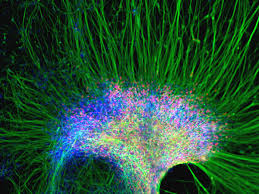
One cell-signaling pathway the team identified, known as p38 MAPK, appears to be a major player in making or breaking the skeletal muscle stem cell, or satellite cell, renewal process in adult mice, said Olwin of the molecular, cellular and developmental biology department. Hyperactivation of the p38 MAPK cell-signaling pathway inhibits the renewal of muscle stem cells in aged mice, perhaps because of cellular stress and inflammatory responses acquired during the aging process.
The researchers knew that obliterating the p38 MAPK pathway in the stem cells of adult mice would block the renewal of satellite cells, said Olwin. But when the team only partially shut down the activity in the cell-signaling pathway by using a specific chemical inhibitor, the adult satellite cells showed significant renewal, he said. “We showed that the level of signaling from this cellular pathway is very important to the renewal of the satellite cells in adult mice, which was a very big surprise,” said Olwin.
A paper on the subject appeared online Feb. 16 in the journal Nature Medicine.
One reason the CU-Boulder study is important is that the results could lead to the use of low-dose inhibitors, perhaps anti-inflammatory compounds, to calm the activity in the p38 MAPK cell-signaling pathway in human muscle stem cells, said Olwin.
The CU-Boulder research team also identified a second cell-signaling pathway affecting skeletal muscle renewal – a receptor known as the fibroblast growth factor receptor-1, or FGFR-1. The researchers showed when the FGFR-1 receptor protein was turned on in specially bred lab mice, the renewal of satellite cells increased significantly. “We still don’t understand how that particular mechanism works,” he said.
Another major finding of the study was that while satellite cells transplanted from young mice to other young mice showed significant renewal for up to two years, those transplanted from old mice to young mice failed. “We found definitively that satellite cells from an aged mouse are not able to maintain the ability to replenish themselves,” Olwin said. “This is likely one of the contributors to loss of muscle mass during the aging process of humans.”
Co-authors included first author and CU-Boulder postdoctoral researcher Jennifer Bernet, former CU-Boulder graduate student John K. Hall, CU-Boulder undergraduate Thomas Carter, and CU-Boulder postdoctoral researchers Jason Doles and Kathleen Kelly-Tanaka. The National Institutes of Health and the Ellison Medical Foundation funded the study.
Olwin said skeletal muscle function and mass decline with age in humans beginning at roughly age 40. While there are a variety of muscle-wasting diseases — ranging from muscular dystrophy to Lou Gehrig’s disease — the condition known as sarcopenia can lead to severe muscle loss, frailty and eventual death and is leading to skyrocketing health care costs for the elderly. “If you live long enough, you’ll get it,” he said.
Olwin and his team worked closely on the research with a team from Stanford University led by Professor Helen Blau, which published a companion paper in the same issue of Nature Medicine. “We shared data with the Stanford team during the entire process and we all were very pleased with the study outcomes,” said Olwin. “This is how science should work.”

Feb 12th
Recently derived equations that describe development patterns in modern urban areas appear to work equally well to describe ancient cities settled thousands of years ago, according to a new study led by a researcher at the University of Colorado Boulder.
“This study suggests that there is a level at which every human society is actually very similar,” said Scott Ortman, assistant professor of anthropology at CU-Boulder and lead author of the study published in the journal PLOS ONE. “This awareness helps break down the barriers between the past and present and allows us to view contemporary cities as lying on a continuum of all human settlements in time and place.”
Over the last several years, Ortman’s colleagues at the Santa Fe Institute (SFI), including Professor Luis Bettencourt, a co-author of the study, have developed mathematical models that describe how modern cities change as their populations grow. For example, scientists know that as a population increases, its settlement area becomes denser, while infrastructure needs per capita decrease and economic production per capita rises.

Ortman noticed that the variables used in these equations, such as cost of moving around, the size of the settled area, the population, and the benefits of people interacting, did not depend on any particular modern technology.
“I realized that if these models are adequate for explaining what’s going on in contemporary cities, they should apply to any settlements in any society,” he said. “So if these models are on the right track, they should apply to ancient societies too.”
To test his idea, Ortman used data that had been collected in the 1960s about 1,500 settlements in central Mexico that spanned from 1,150 years B.C. through the Aztec period, which ended about 500 years ago. The data included the number of dwellings the archaeologists were able to identify, the total settled area and the density of pottery fragments scattered on the surface. Taken together, these artifacts give an indication of the total population numbers and settlement density of the ancient sites.
“We started analyzing the data in the ways we were thinking about with modern cities, and it showed that the models worked,” Ortman said.
The discovery that ancient and modern settlements may develop in similar and predictable ways has implications both for archaeologists and people studying today’s urban areas. For example, it’s common for archaeologists to assume that population density is constant, no matter how large the settlement area, when estimating the population of ancient cities. The new equations could offer a way for archaeologists to get a more accurate head count, by incorporating the idea that population density tends to grow as total area increases.
In the future, the equations may also guide archaeologists in getting an idea of what they’re likely to find within a given settlement based on its size, such as the miles of roads and pathways. The equations could also guide expectations about the number of different activities that took place in a settlement and the division of labor.
“There should be a relationship between the population of settlements and the productivity of labor,” Ortman said. “So, for example, we would expect larger social networks to be able to produce more public monuments per capita than smaller settlements.”
The findings of the new study may also be useful to studies of modern societies. Because ancient settlements were typically less complex than today’s cities, they offer a simple “model system” for testing the equations devised to explain modern cities.
“The archaeological record actually provides surprisingly clear tests of these models, and in some cases it’s actually much harder to collect comparable data from contemporary cities,” Ortman said.
Other co-authors of the study include Andrew Cabaniss of Santa Fe Institute and the University of North Carolina Chapel Hill and Jennie Sturm of the University of New Mexico.
The study is available at http://dx.plos.org/10.1371/journal.pone.0087902.
-CU-

Jan 30th
This article originally appeared on The Daily Climate, the climate change news source published by Environmental Health Sciences, a nonprofit media company.

A shift to untraceable donations by organizations denying climate change undermines democracy, according to the author of a new study tracking contributions to such groups. Image: Wikimedia Commons/Carol M. Highsmith The largest, most-consistent money fueling the climate denial movement are a number of well-funded conservative foundations built with so-called “dark money,” or concealed donations, according to an analysis released Friday afternoon.The study, by Drexel University environmental sociologist Robert Brulle, is the first academic effort to probe the organizational underpinnings and funding behind the climate denial movement. It found that the amount of money flowing through third-party, pass-through foundations like DonorsTrust and Donors Capital, whose funding cannot be traced, has risen dramatically over the past five years.
In all, 140 foundations funneled $558 million to almost 100 climate denial organizations from 2003 to 2010.
Meanwhile the traceable cash flow from more traditional sources, such as Koch Industries and ExxonMobil, has disappeared.
The study was published Friday in the journal Climatic Change.

Catastrophic weather events have increased as the atmosphere warms
“The climate change countermovement has had a real political and ecological impact on the failure of the world to act on global warming,” Brulle said in a statement. “Like a play on Broadway, the countermovement has stars in the spotlight – often prominent contrarian scientists or conservative politicians – but behind the stars is an organizational structure of directors, script writers and producers.”
“If you want to understand what’s driving this movement, you have to look at what’s going on behind the scenes.”
Consistent funders
To uncover that, Brulle developed a list of 118 influential climate denial organizations in the United States. He then coded data on philanthropic funding for each organization, combining information from the Foundation Center, a database of global philanthropy, with financial data submitted by organizations to the Internal Revenue Service.
According to Brulle, the largest and most consistent funders where a number of conservative foundations promoting “ultra-free-market ideas” in many realms, among them the Searle Freedom Trust, the John Williams Pope Foundation, the Howard Charitable Foundation and the Sarah Scaife Foundation.
Another key finding: From 2003 to 2007, Koch Affiliated Foundations and the ExxonMobil Foundation were “heavily involved” in funding climate change denial efforts. But Exxon hasn’t made a publically traceable contribution since 2008, and Koch’s efforts dramatically declined, Brulle said.
Coinciding with a decline in traceable funding, Brulle found a dramatic rise in the cash flowing to denial organizations from DonorsTrust, a donor-directed foundation whose funders cannot be traced. This one foundation, the assessment found, now accounts for 25 percent of all traceable foundation funding used by organizations promoting the systematic denial of climate change.
Jeffrey Zysik, chief financial officer for DonorsTrust, said in an email that neither DonorsTrust nor Donors Capital Fund “take positions with respect to any issue advocated by its grantees.”
“As with all donor-advised fund programs, grant recommendations are received from account holders,” he said. “DonorsTrust and Donors Capital Fund ensure that recommended grantees are IRS-approved public charities and also require that the grantee charities do not rely on significant amounts of revenue from government sources. DonorsTrust and Donors Capital Fund do not otherwise drive the selection of grantees, nor conduct in-depth analyses of projects or grantees unless an account holder specifically requests that service.”
Matter of democracy
In the end, Brulle concluded public records identify only a fraction of the hundreds of millions of dollars supporting climate denial efforts. Some 75 percent of the income of those organizations, he said, comes via unidentifiable sources.
And for Brulle, that’s a matter of democracy. “Without a free flow of accurate information, democratic politics and government accountability become impossible,” he said. “Money amplifies certain voices above others and, in effect, gives them a megaphone in the public square.”
Powerful funders, he added, are supporting the campaign to deny scientific findings about global warming and raise doubts about the “roots and remedies” of a threat on which the science is clear.
“At the very least, American voters deserve to know who is behind these efforts.”
Editor’s Note (12/24/13): This story has been updated to reflect a late comment from DonorsTrust.