








Mar 13th
A revolutionary University of Colorado Boulder toilet fueled by the sun that is being developed to help some of the 2.5 billion people around the world lacking safe and sustainable sanitation will be unveiled in India this month.
The self-contained, waterless toilet, designed and built using a $777,000 grant from the Bill & Melinda Gates Foundation, has the capability of heating human waste to a high enough temperature to sterilize human waste and create biochar, a highly porous charcoal, said project principal investigator Karl Linden, professor of environmental engineering. The biochar has a one-two punch in that it can be used to both increase crop yields and sequester carbon dioxide, a greenhouse gas.
The project is part of the Gates Foundation’s “Reinvent the Toilet Challenge,” an effort to develop a next-generation toilet that can be used to disinfect liquid and solid waste while generating useful end products, both in developing and developed nations, said Linden. Since the 2012 grant, Linden and his CU-Boulder team have received an additional $1 million from the Gates Foundation for the project, which includes a team of more than a dozen faculty, research professionals and students, many working full time on the effort.

According to the Gates Foundation, the awards recognize researchers who are developing ways to manage human waste that will help improve the health and lives of people around the world. Unsafe methods to capture and treat human waste result in serious health problems and death – food and water tainted with pathogens from fecal matter results in the deaths of roughly 700,000 children each year.
Linden’s team is one of 16 around the world funded by the Gates “Reinvent the Toilet Challenge” since 2011. All have shipped their inventions to Delhi, where they will be on display March 20-22 for scientists, engineers and dignitaries. Other institutional winners of the grants range from Caltech to Delft University of Technology in the Netherlands and the National University of Singapore.
The CU-Boulder invention consists of eight parabolic mirrors that focus concentrated sunlight to a spot no larger than a postage stamp on a quartz-glass rod connected to eight bundles of fiber-optic cables, each consisting of thousands of intertwined, fused fibers, said Linden. The energy generated by the sun and transferred to the fiber-optic cable system — similar in some ways to a data transmission line — can heat up the reaction chamber to over 600 degrees Fahrenheit to treat the waste material, disinfect pathogens in both feces and urine, and produce char.
“Biochar is a valuable material,” said Linden. “It has good water holding capacity and it can be used in agricultural areas to hold in nutrients and bring more stability to the soils.” A soil mixture containing 10 percent biochar can hold up to 50 percent more water and increase the availability of plant nutrients, he said. Additionally, the biochar can be burned as charcoal and provides energy comparable to that of commercial charcoal.
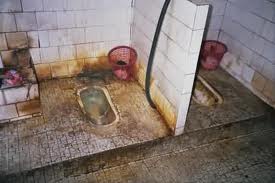
Most public toilets look like this
Linden is working closely with project co-investigators Professor R. Scott Summers of environmental engineering and Professor Alan Weimer chemical and biological engineering and a team of postdoctoral fellows, professionals, graduate students, undergraduates and a high school student.
“We are doing something that has never been done before,” said Linden. “While the idea of concentrating solar energy is not new, transmitting it flexibly to a customizable location via fiber-optic cables is the really unique aspect of this project.” The interdisciplinary project requires chemical engineers for heat transfer and solar energy work, environmental engineers for waste treatment and stabilization, mechanical engineers to build actuators and moving parts and electrical engineers to design control systems, Linden said.
Tests have shown that each of the eight fiber-optic cables can produce between 80 and 90 watts of energy, meaning the whole system can deliver up to 700 watts of energy into the reaction chamber, said Linden. In late December, tests at CU-Boulder showed the solar energy directed into the reaction chamber could easily boil water and effectively carbonize solid waste.
While the current toilet has been created to serve four to six people a day, a larger facility that could serve several households simultaneously is under design with the target of meeting a cost level of five cents a day per user set by the Gates Foundation. “We are continuously looking for ways to improve efficiency and lower costs,” he said.
“The great thing about the Gates Foundation is that they provide all of the teams with the resources they need,” Linden said. “The foundation is not looking for one toilet and one solution from one team. They are nurturing unique ideas and looking at what the individual teams bring overall to the knowledge base.”
Linden, who called the 16 teams a “family of researchers,” said the foundation has funded trips for CU-Boulder team members to collaborate with the other institutions in places like Switzerland, South Africa and North Carolina. “Instead of sink or swim funding, they want every team to succeed. In some ways we are like a small startup company, and it’s unlike any other project I have worked on during my career,” he said.
CU-Boulder team member Elizabeth Travis from Parker, Colo., who is working toward a master’s degree in the engineering college’s Mortenson Center in Engineering for Developing Communities, said her interest in water and hygiene made the Reinvent the Toilet project a good fit. “It is a really cool research project and a great team,” she said. “Everyone is very creative, patient and supportive, and there is a lot of innovation. It is exciting to learn from all of the team members.”
“We have a lot of excitement and energy on our team, and the Gates Foundation values that,” Linden said. “It is one thing to do research, another to screw on nuts and bolts and make something that can make a difference. To me, that’s the fun part, and the project is a nice fit for CU-Boulder because we have a high interest in developing countries and expertise in all of the renewable energy technologies as well as sanitation.”
The CU-Boulder team is now applying for phase two of the Gates Foundation Reinvent the Toilet grant to develop a field-worthy system to deploy in a developing country based on their current design, and assess other technologies that may enhance the toilet system, including the use of high-temperature fluids that can collect, retain and deliver heat.
-CU-
Sep 10th
The City of Boulder announced today that it will create a working group of solar industry specialists and customers – both current and future – to explore motivators and barriers to implementing more solar throughout the community. The focus of the group’s work will be on defining the next-generation of incentives as well as providing guidance about how to handle solar contracts between now and the time when the city decides whether it will create a local electric utility.
“Supporting and increasing renewable sources of energy is a core value, and we see this discussion as an important next step in our effort to create the electric utility of the future,” said Heather Bailey, executive director of Energy Strategy and Electric Utility Development.

Bailey said the city has a unique opportunity to benefit from local experts to design programs that will encourage more local energy production. Expertise from the university and federal labs, as well as the numerous companies and entrepreneurs developing leading-edge energy technologies, has already helped Boulder achieve one of the highest levels of solar per-capita in the US, with close to 14 megawatts installed in the city.
The City of Boulder has also played a significant role in supporting local energy generation, particularly solar. This has included streamlining the permitting process to offering a local solar rebate and grant program. The concept of Solar Gardens was originally conceived in Boulder, and city staff members were on the drafting team of legislation that allowed this. The solar gardens law was signed by then-Governor Bill Ritter overlooking the Flatirons from a parking lot rooftop along the Pearl Street Mall.
“We don’t want to simply continue this tradition; we want to make it even stronger by working with stakeholders to identify ways to encourage even more locally generated clean energy sources. This is fundamental to achieving our community’s goals, whether we create our own electric utility or strike a new agreement with our current provider, Xcel Energy,” Bailey said.
One of the questions the city would like to resolve is how to encourage continued participation in solar installations during the ongoing deliberation about – and possible transition to – a local electric utility. Xcel Energy recently sent the city a letter requesting that the city agree to take over contracts it has with customers if Boulder forms an electric retail utility.
The City of Boulder is committed to protecting those who have made investments in solar energy in our community from any adverse impact related to the creation of a municipal utility. The city is also interested in working with Xcel on this important issue, not only to protect those who have already made investments, but to encourage growth in this area of renewable energy.
Boulder has no way, however, of evaluating the estimates that Xcel has made about these costs.
“Before we can agree to any arrangement, we need more information from Xcel Energy,” City Attorney Tom Carr said. “The company so far has declined most of the requests for data the city has made. Without detailed information about these contracts, we have no way of verifying Xcel’s assertions and perhaps more importantly, of making sure we are doing the right thing to protect our forward-thinking customers and other ratepayers.”
The city’s Energy Future team anticipates holding the first meeting of the solar working group shortly after the Nov. 5 election. Members of the community and industry who are interested in participating are encouraged to contact Heather Bailey at 33-441-1923 or baileyh@bouldercolorado.gov.
More information about the Energy Future project is available at www.BoulderEnergyFuture.com.
–CITY–
Jul 21st
In fact, two CU-Boulder researchers say all that may have been required to sustain liquid water and primitive life on Earth during the Archean eon 2.8 billion years ago were reasonable atmospheric carbon dioxide amounts believed to be present at the time and perhaps a dash of methane. The key to the solution was the use of sophisticated three-dimensional climate models that were run for thousands of hours on CU’s Janus supercomputer, rather than crude, one-dimensional models used by almost all scientists attempting to solve the paradox, said doctoral student Eric Wolf, lead study author.

“It’s really not that hard in a three-dimensional climate model to get average surface temperatures during the Archean that are in fact moderate,” said Wolf, a doctoral student in CU-Boulder’s atmospheric and oceanic sciences department. “Our models indicate the Archean climate may have been similar to our present climate, perhaps a little cooler. Even if Earth was sliding in and out of glacial periods back then, there still would have been a large amount of liquid water in equatorial regions, just like today.”
Evolutionary biologists believe life arose on Earth as simple cells roughly 3.5 billion years ago, about a billion years after the planet is thought to have formed. Scientists have speculated the first life may have evolved in shallow tide pools, freshwater ponds, freshwater or deep-sea hydrothermal vents, or even arrived on objects from space.
A cover article by Wolf and Toon on the topic appears in the July issue of Astrobiology. The study was funded by two NASA grants and by the National Science Foundation, which supports CU-Boulder’s Janus supercomputer used for the study.
Scientists have been trying to solve the faint young sun paradox since 1972, when Cornell University scientist Carl Sagan — Toon’s doctoral adviser at the time — and colleague George Mullen broached the subject. Since then there have been many studies using 1-D climate models to try to solve the faint young sun paradox — with results ranging from a hot, tropical Earth to a “snowball Earth” with runaway glaciation — none of which have conclusively resolved the problem.
“In our opinion, the one-dimensional models of early Earth created by scientists to solve this paradox are too simple — they are essentially taking the early Earth and reducing it to a single column atmospheric profile,” said Toon. “One-dimensional models are simply too crude to give an accurate picture.”
Wolf and Toon used a general circulation model known as the Community Atmospheric Model version 3.0 developed by the National Center for Atmospheric Research in Boulder and which contains 3-D atmosphere, ocean, land, cloud and sea ice components. The two researchers also “tuned up” the model with a sophisticated radiative transfer component that allowed for the absorption, emission and scattering of solar energy and an accurate calculation of the greenhouse effect for the unusual atmosphere of early Earth, where there was no oxygen and no ozone, but lots of CO2 and possibly methane.
The simplest solution to the faint sun paradox, which duplicates Earth’s present climate, involves maintaining roughly 20,000 parts per million of the greenhouse gas CO2 and 1,000 ppm of methane in the ancient atmosphere some 2.8 billion years ago, said Wolf. While that may seem like a lot compared to today’s 400 ppm of CO2 in the atmosphere, geological studies of ancient soil samples support the idea that CO2 likely could have been that high during that time period. Methane is considered to be at least 20 times more powerful as a greenhouse gas than CO2 and could have played a significant role in warming the early Earth as well, said the CU researchers.
There are other reasons to believe that CO2 was much higher in the Archean, said Toon, who along with Wolf is associated with CU’s Laboratory for Atmospheric and Space Physics. The continental area of Earth was smaller back then so there was less weathering of the land and a lower release of minerals to the oceans. As a result there was a smaller conversion of CO2 to limestone in the ocean. Likewise, there were no “rooted” land plants in the Archean, which could have accelerated the weathering of the soils and indirectly lowered the atmospheric abundance of CO2, Toon said.
Another solution to achieving a habitable but slightly cooler climate under the faint sun conditions is for the Archean atmosphere to have contained roughly 15,000 to 20,000 ppm of CO2 and no methane, said Wolf. “Our results indicate that a weak version of the faint young sun paradox, requiring only that some portion of the planet’s surface maintain liquid water, may be resolved with moderate greenhouse gas inventories,” the authors wrote in Astrobiology.
“Even if half of Earth’s surface was below freezing back in the Archean and half was above freezing, it still would have constituted a habitable planet since at least 50 percent of the ocean would have remained open,” said Wolf. “Most scientists have not considered that there might have been a middle ground for the climate of the Archean.
“The leap from one-dimensional to three-dimensional models is an important step,” said Wolf. “Clouds and sea ice are critical factors in determining climate, but the one-dimensional models completely ignore them.”
Has the faint young sun paradox finally been solved? “I don’t want to be presumptuous here,” said Wolf. “But we show that the paradox is definitely not as challenging as was believed over the past 40 years. While we can’t say definitively what the atmosphere looked like back then without more geological evidence, it is certainly not a stretch at all with our model to get a warm early Earth that would have been hospitable to life.”
“The Janus supercomputer has been a tremendous addition to the campus, and this early Earth climate modeling project would have impossible without it,” said Toon. The researchers estimated the project required roughly 6,000 hours of supercomputer computation time, an effort equal to about 10 years on a home computer.
-CU-
[includeme src=”http://c1n.tv/boulder/media/bouldersponsors.html” frameborder=”0″ width=”670″ height=”300″]