








Oct 27th
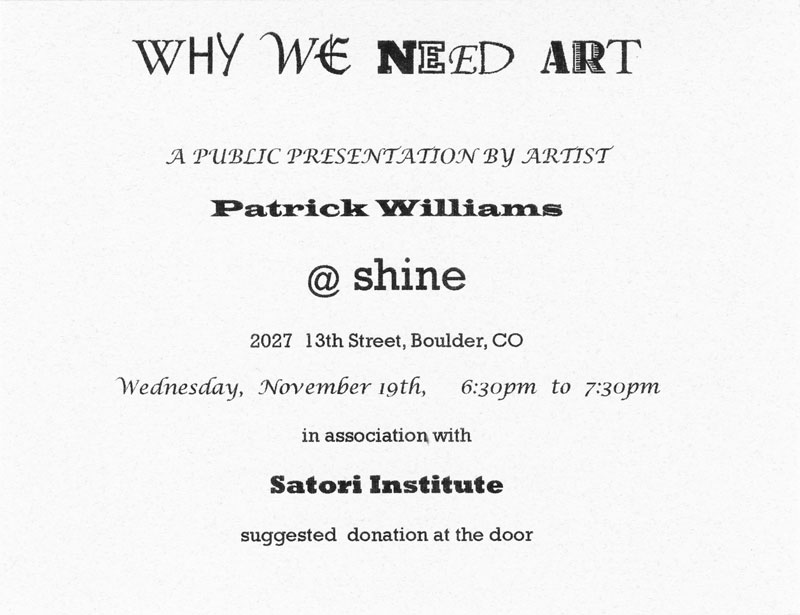
No matter how buried or forgotten we all have the embers of Creativity within us. This presentation is for everyone who desires and dares to access, maintain, and sustain their Creativity and will point people in the right direction toward rekindling our Creative embers and turning them into Creative flames.
 Patrick is a visionary educator, accomplished artist, and independent scholar. Patrick Williams runs his own for profit art, speaking, and consulting business as well as being the Creative Director and Operations Manager of Satori Institute, A research based non-profit organization.
With over three decades of experience, Patrick has innovated creative curriculums and taught children and adults art, creativity, new science, budo, and art history in public and private schools, community centers, teacher trainings, and mentorship experiences.
Patrick’s paintings and drawings have been shown in many solo exhibits and group shows throughout the United States, Japan, and China. His work has been represented by galleries in Chicago, Seattle, Albuquerque, and Omaha.
He holds black belts in Karate-do and Aikido and has trained and taught budo for more than thirty-five years. He also practices Kyudo, Japanese archery. Patrick has an expansive and comprehensive knowledge of art history and holds a BFA in painting from the University of Nebraska.
patrickwilliams.com
satoriinstitute.org
Aug 27th
Rodwin Architecture is an award-winning green firm located in Boulder, Colorado experienced in both residential and commercial projects of all sizes. Known for their design excellence, friendly, responsive service, and expertise in sustainable design. Rodwin Architecture offers complete architectural, interior and landscape design services and has a proven track record in planning, feasibility, construction management and development.
Skycastle Homes works in partnership with the design team at Rodwin Architecture, as a green design/build company in Boulder, Colorado. They are also known for design excellence, quality construction, friendly, responsive service, business integrity, and an unmatched expertise in sustainable design. From new million dollar custom homes to budget-minded remodels.

1245 Pearl Street, Suite 202
Boulder, CO 80302
Phone: (303) 413-8556
Fax: (303) 413-8557
Email: scott@rodwinarch.com
Website: www.rodwinarch.com
Map & Reviews



Jun 14th
A new DNA analysis of rocky soils in the Martian-like landscape on some volcanoes in South America has revealed a handful of bacteria, fungi and other rudimentary organisms called archaea, which seem to have a different way of converting energy than their cousins elsewhere in the world.

“We haven’t formally identified or characterized the species,” said Ryan Lynch, a CU-Boulder doctoral student involved in the study. “But these are very different than anything else that has been cultured. Genetically, they’re at least 5 percent different than anything else in the DNA database of 2.5 million sequences.”
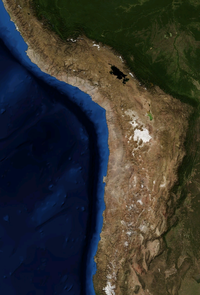
Life gets little encouragement on the incredibly dry slopes of the tallest volcanoes in the Atacama region, where CU-Boulder Professor Steve Schmidt and his team collected soil samples. Much of the sparse snow that falls on the terrain sublimates back to the atmosphere soon after it hits the ground, and the soil is so depleted of nutrients that nitrogen levels in the scientists’ samples were below detection limits.
One of the most hostile environments on the planet
Ultraviolet radiation in the high-altitude environment can be twice as intense as in a low-elevation desert, said Schmidt of CU-Boulder’s ecology and evolutionary biology department. While the researchers were on site, temperatures dropped to 14 degrees Fahrenheit one night and spiked to 133 F the next day.
How the newfound organisms survive under such circumstances remains a mystery. Although Ryan, Schmidt and their colleagues looked for genes known to be involved in photosynthesis and peered into the cells using fluorescent techniques to look for chlorophyll, they couldn’t find evidence that the microbes were photosynthetic.
Instead, they think the microbes might slowly generate energy by means of chemical reactions that extract energy and carbon from wisps of gases such as carbon monoxide and dimethylsulfide that blow into the desolate mountain area. The process wouldn’t give the bugs a high-energy yield, Lynch said, but it could be enough as it adds up over time. A paper on the findings has been accepted by the Journal of Geophysical Research-Biogeosciences, published by the American Geophysical Union.
While normal soil has thousands of microbial species in just a gram of soil, and garden soils even more, remarkably few species have made their home in the barren Atacama mountain soil, the new research suggests. “To find a community dominated by less than 20 species is pretty amazing for a soil microbiologist,” Schmidt said.
Nearly 20,000 feet in altitude, snowless for 48,000 years
He has studied sites in the Peruvian Andes where, four years after a glacier retreats, there are thriving, diverse microbe communities. But on these volcanoes on the Chile-Argentina border, which rise to altitudes of more than 19,685 feet and which have been ice-free for 48,000 years, the bacterial and fungal ecosystems have not undergone succession to more diverse communities. “It’s mostly due to the lack of water, we think,” he said. “Without water, you’re not going to develop a complex community.”
“Overall, there was a good bit lower diversity in the Atacama samples than you would find in most soils, including other mountainous mineral soils,” Lynch said. That makes the Atacama microbes very unusual, he added. They probably had to adapt to the extremely harsh environment, or may have evolved in different directions than similar organisms elsewhere due to long-term geographic isolation.
Growth on the mountain might be intermittent, Schmidt suggested, especially if soils only have water for a short time after snowfall. In those situations, there could be microbes that grow when it snows, then fall dormant, perhaps for years, before they grow again. High-elevation sites are great places to study simple microbial communities, ecosystems that haven’t evolved past the very basics of a few bacteria and fungi, Schmidt said.
“There are a lot of areas in the world that haven’t been studied from a microbial perspective, and this is one of the main ones,” he said. “We’re interested in discovering new forms of life, and describing what those organisms are doing, how they make a living.”
Schmidt’s lab, along with others, is studying how microorganisms travel from one site to another. One common method of microbe transport is through the air — they’re caught up in winds, sucked up into clouds, form rain droplets and then fall back to the ground somewhere else as precipitation.

But on mountains like Volcán Llullaillaco and Volcán Socompa, the high UV radiation and extreme temperatures make the landscape inhospitable to outside microbes. “This environment is so restrictive, most of those things that are raining down are killed immediately,” Schmidt said. “There’s a huge environmental filter here that’s keeping most of these things from growing.”
The next steps for the researchers are laboratory experiments using an incubator that can mimic the extreme temperature fluctuations to better understand how any organism can live in such an unfriendly environment. Studying the microbes and finding out how they can live at such an extreme can help set boundaries for life on Earth, Schmidt said, and tells scientists what life can stand. There’s a possibility that some of the extremophiles might utilize completely new forms of metabolism, converting energy in a novel way.
Schmidt also is working with astrobiologists to model what past conditions were like on Mars. With their rocky terrain, thin atmosphere and high radiation, the Atacama volcanoes are some of the most similar places on Earth to the Red Planet.
“If we know, on Earth, what the outer limits for life were, and they know what the paleoclimates on Mars were like, we may have a better idea of what could have lived there,” he said.
Other paper authors included Andrew King of Ecosystem Sciences, CSIRO Black Mountain in Acton, Australia; Mariá Farías of Laboratorio de Investigaciones Microbiologicas de Lagunas Andinas, Planto Piloto de Procesos Industriales Microbiologicas, CCT, CONICET in Tucuman, Argentina; Preston Sowell of Geomega, an environmental consulting firm in Boulder; and Christian Vitry of Museo de Arqueologia de Alta Montana in Salta, Argentina.