







We moved Boulder Crime News and police blotter out of News and made it a primary category. Even though crime news is the highest in analytic s some readers complain because it ruins non violent news. Our readers and viewers prefer science, tech environmental and entertainment news. So crime news junkies now have your own bad news section here.

Sep 30th
BOULDER, Colo. — SEPTEMBER 30, 2026 A high-tech police drone helped take a dangerous felon off the streets today following a tense midday standoff in south Boulder.Just before noon, a caller reported two men pointing firearms at each other near Baseline Road and Broadway.
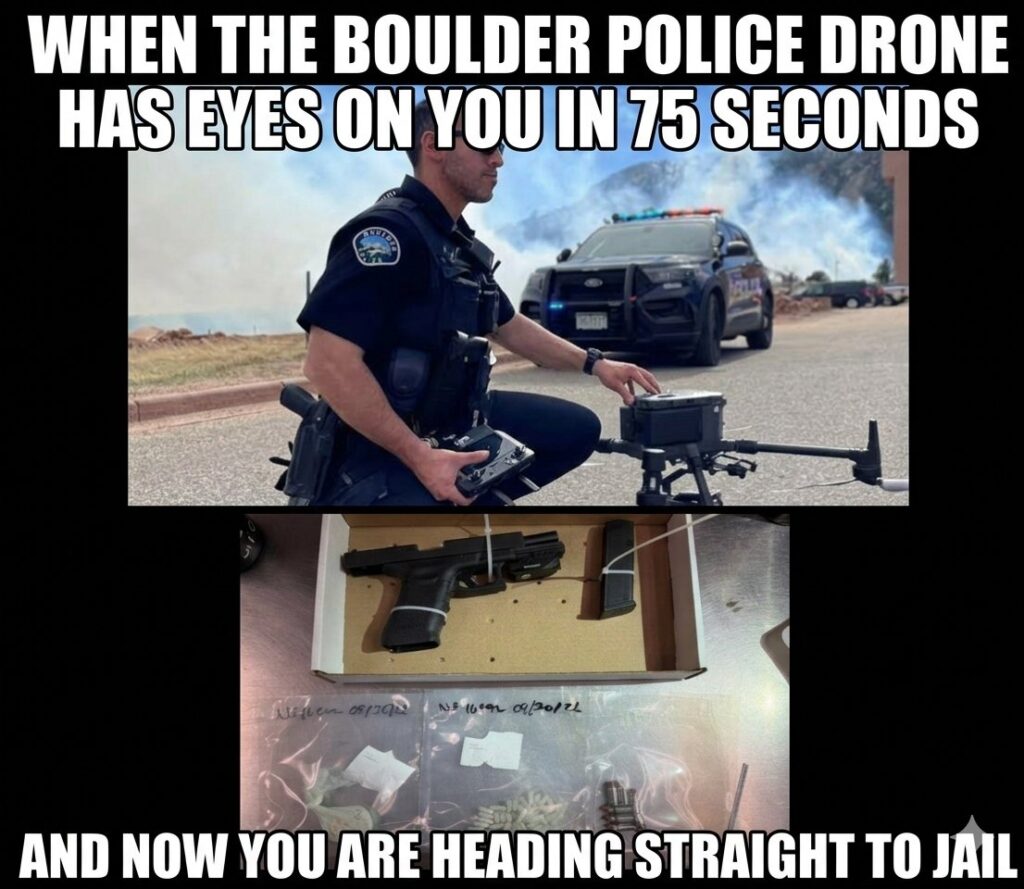
Within a stunning 75 seconds, the Boulder Police Department’s Drone as First Responder (DFR) located the suspects sitting in separate trucks at a traffic light.Patrol officers swiftly converged on the scene, conducting a high-risk traffic stop and taking both men into custody at gunpoint. Following an on-scene investigation, one driver was released.
The other driver, Quinn Sims, 38, of Commerce City, was arrested. Sims, a registered sex offender with an active Denver warrant, has a violent criminal history including assault with a deadly weapon. Inside his truck, officers recovered a firearm and nearly 30 grams of illegal drugs.
Sims faces multiple new charges, including felony menacing, possession of a weapon by a convicted felon, and drug distribution.”In less than two minutes, our drone found individuals threatening our community with guns,” said Boulder Police Chief Steve Redfearn, praising the coordinated, injury-free arrest.Sims was booked into the Boulder County Jail.

Sep 27th
Police reports are still extremely slow coming in, but I did get one yesterday. It is summarized below 👇 Anyone not on Nextdoor can view this content here: https://boulderpublicsafety.org/2026/09/25/reporting-update-9-25-26/ As always, you can view my entire collection of reports here: https://boulderpublicsafety.org/ * Reminder, the more people share these links with others and click on them, the higher they will rank as Google search results. This is something very easy which you can do to help me. * Presently,

I have approximately 37 outstanding requests for incidents dating back to July 10th (now well over two months ago). The police have repeatedly stated their records department is short-staffed. However, per City Council’s study session materials from last night (9/24), 12 of the department’s 13 records positions are currently filled. No one on council raised the issue of the records backlog. Reports I have requested but not yet received include: 9/16: A Menacing J/O (just occurred) at 14xx Canyon. This would have been at or near the Circle K downtown. A man was arrested on charges of: 2nd Degree Assault – Sbi – Police Officer – Strongarm – (F4) Criminal Attempt To Commit Class Three Felony – (F4) Criminal Mischief – Private – [$300 to < $1,000] – (M2) Obstructing A Peace Officer/Firefighter/Emt – (M2) Robbery – Street – Strongarm – (F4) => This man was booked under the name “John Doe.” As of 9/25, the Boulder County Jail listing still identifies the man by that name. 9/18: Another Menacing J/O (just occurred) at 12xx Canyon Blvd. This would have been at or near Central Park. A man was arrested on charges of: Menacing – Intimidation – Use/Simulate Firearm/Knife/Budgeon (F5) Possession Of Drug Paraphernalia – (Dpo) Unlawful Dist/Man/Disp/Sale/PWID – Amphetamine – PWID < 7 Grams (DF3) Unlawful Dist/Man/Sale/Poss/PWID – Fentanyl/Synthetic Opioid – < 4 Grams (DF3) 9/19: Yet another Menacing J/O (just occurred) at 16xx 30th Street. This would have been at or near the King Soopers on 30th A man was arrested on a charge of: (Legacy) MENACING – AGG ASSAULT – WEAPON – (F5) => At the man’s 9/21 court appearance, the judge ordered him to stay away from this King Soopers and specified he wasn’t allowed to have any weapons, including knives. 9/19: A Menacing C (cold), at 12xx Canyon Blvd (also Central Park). This call generated a report; however, I don’t know if anyone was arrested. ~~~~~~~~~~~~~~~~~~~~ THE ONE REPORT I HAVE GOTTEN SINCE 9/13: 8/26 1325 Pearl Street, the Pearl Street Mall 6:50 PM Officers responded to the mall after receiving reports of a shirtless man yelling that he was going to kill people and stealing a chair from a deli near Broadway and Pearl. An employee told police the man had entered the restaurant several times before taking the chair and leaving it in an alley, where employees recovered it. Police contacted the man near the public restrooms at 13th and Pearl. According to the report, he repeatedly yelled racist and homophobic slurs, refused to identify himself, and asked for a blanket because he was cold. Officers gave him an emergency blanket, but he discarded it and asked for a hoodie instead. Police said he became increasingly hostile, advanced toward officers, and repeatedly reached into his pockets despite being told to keep his hands visible. An officer drew a Taser, and the man eventually removed a lighter from his pocket and threw it on the ground. Officers then took him to the ground and handcuffed him. The man asked for medical attention and was taken to Boulder Community Health before being booked into jail. Police said he continued yelling racist and homophobic slurs at the hospital and made a sexually graphic comment to a nurse who was helping him. He later began thrashing on the hospital bed and kicked an officer’s hand. (The officer was not injured.) After being medically cleared, the man allegedly got off the bed and tried to move toward the door while an officer was outside retrieving a spit hood. Another officer grabbed his handcuffs, called for emergency assistance and took him to the floor. The man was taken to jail. The original police report listed charges including 2nd Degree Assault on a Peace Officer, Obstruction, Theft Under $300, and an attempted felony charge that is not further clarified in the report. Police also recovered 12.64 grams (about 0.44 oz) of marijuana. The man was scheduled for a preliminary hearing on 9/24. As of 9/25, the Boulder County Jail listing shows only one charge, misdemeanor 3rd Degree Assault. The available records do not indicate what occurred at the 9/24 hearing or explain the reduction in charges.Reporting Update — 9/25/26boulderpublicsafety.orgCommentShare
24 reactions10 commentsAnn S.2d·WhittierNothing says welcome to tourists and the dinner crowd like racist & homophobic slurs as well as threats of physical violence, Sundance is going to love this kind of local color. Thanks for getting this report!Reply
10Todd R.2d·Author·WhittierAnn The report was very graphic about the racist and homophobic slurs the man was using at officers. The sexual comment that he made to the nurse at the hospital was also quite graphic. It’s too bad Nextdoor wouldn’t allow it to be reprinted as a quote.Reply
4See 2 more repliesCathy D.2d·The HillThank you, Todd, for your time and work to keep us informed.Reply
13Graeme Forbes1d·East BoulderIndeed, Cathy. Thanks Todd.Reply
1Liana Patterson1d·Hillsborough NorthTerribleReplyTodd R.1d·Author·Whittier
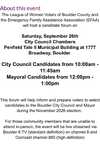
There is a city council candidate forum tomorrow (Sat) at the Muni building from 10 AM – 1 PM. This is your chance to meet the people who will soon be ignoring your concerns about public safety 🎉 https://lwvbc.org/content.aspx?page_id=4091&club_id=629866&item_id=3043309Reply
6Roxanna Walker1d·The HillTodd hoping for another chance. These dates don’t work for us.ReplyEmie F.1d·Winding TrailAnother day in the emergency department!

May 2nd
Boulder Colorado May 2, 2026 Boulder Channel 1 News Feature These are excerpts from 4 boulder journalists who cover crime. They have been hog tied by Boulder Police department and Boulder city council.
Steve Lynton is a retired News Reporter who write about city news on Nextdoor He has covered crime and war and city beats for over 30 years. He is a seasoned news reporter Yup, Todd is not only “Boulder’s independent crime journalist”–he is, in fact, the only person in Boulder who provides regular reporting on criminal incidents in this city, perhaps the most fundamental requirement of news coverage in a municipality. That’s because Boulder is a news desert.
The Daily Camera only reports what BPD’s PR reps choose to post in their occasional news releases. Once in a while, the Camera also publishes details from a police statement that’s eventually been entered into jail or court records as a result of a criminal proceeding. Broadcast media also only report BPD’s news releases.
As for Boulder Reporting Lab, it’s not a news organization; it’s a “progressive” advocacy organization and, therefore, does not cover crime or criminal justice proceedings. Stacy Feldman, who runs BPR, considers criminal activity to constitute “negative” news, unworthy of mention on her advocacy website. In contrast, Todd does the basic reporting that the media ought to be doing. He obtains incident reports as soon as they become available and reports what he finds on Nextdoor.
Todd also visits the scenes of some criminal incidents and attaches photos of what he observes. He used to report on incidents from scanner traffic. But Redfearn has cracked down on public information and shut off access to scanner traffic. Redfearn also has instituted a system designed to delay and obstruct the release of incident reports and other public information.
This is a city marked by illegal encampments, drug trafficking, overdose deaths, assaults and other criminal incidents, many of them stemming from addiction and mental illness. Downtown shops and restaurants face vandalism and shoplifting. Still, only Todd can be counted on to report news of these recurring incidents. We can observe the mess left by those encampments. But only Todd reports the details of the criminal incidents linked to the encampments and occurring in other neighborhoods.
Todd Root writes Boulder Police Scanner reports. He has been denied access by Boulder police Department, thanks for your comment. I weigh what information to share very carefully for various reasons, including possible harm to those involved. Sometimes I cut stories altogether because it’s just too risky, particularly for the victim(s).
I am happy to answer questions about my thought processes in this regard. The police department doesn’t release reports related to incidents which are still under investigation. However, in some cases, releasing light details – such as that a robbery occurred and police were responding – can convey what happened without compromising anything sensitive. Absent that, we often see broad guesses and speculation from the public, which is also problematic.
I do pull arrest affidavits, as you describe, but I prefer the final police reports because they contains more information, particularly info added after the initial arrest. It is unfortunate that it can take a lot longer. And of course arrest affidavits are only available in cases where someone was arrested.
You are correct that most crimes pose no threat to the public. However, that’s not the only reason to share information about them. There’s also conveying a picture of what the police deal with, since there are people who hate the police based solely on their ideology. And often, public sympathy is the only justice the victim ever sees.
You can view all my past reporting, which I am slowly compiling, here. Let me know if you see information included which you feel is possibly harmful: https://docs.google.com/document/d/e/2PACX-1vRiz7uN7tH7qTCRaiA0TH2keaSjv1S_jbOubCjX5FwHNhTR1TRKIFuup88TWye2PpohnHs20oGKOt9R/pub If you don’t like reading this content, reading it is, of course, optional. If you’re opposed to my doing this work at all, go talk to the Boulder Progressives. This was their idea. They wanted to learn all about this city’s criminal underbelly from me and have never reconsidered that.
Rob Smoke has been a writer for The Daily Camera He writes about Boulder police chief.
When they did the “public interview” process at council chambers with the 3 “finalists”, his presentation was absolutely horrible — every word out of his mouth was a piece of stale cheese — seriously…every single sentence and phrase was something he rehearsed in the shower a very long time ago.
Precisely zero interesting stories about his career or life or anything. I challenge anyone to watch the video and tell me different…outside of a few corrupt council members who undoubtedly knew the outcome before the interview.
He also wouldn’t account for his behavior regarding the police arrest and killing of a young person of color in Aurora, Elijah McClain (in 2019), where he generated a report containing blatantly false information about the suspect’s behavior.
The results highlight the workings of the standard political “buddy system”. If Mark Wallach or Matt Benjamin need a favor from the police, there’s always a guy ready to assist. This circumstance came up over the summer where a young activist drawing with chalk on a sidewalk (it washes off in the rain, people), somehow got arrested for it and in another incident was charged with assault for having a heated conversation with Matt Benjamin and his wife at the Farmer’s Market.
If there’s one thing that’s true about any of this, it’s likely that… regardless of prior standards, we all need to lower our expectations when interacting with City of Boulder police officers. The whole “leading by example” thing is out the window.