








Feb 12th
Recently derived equations that describe development patterns in modern urban areas appear to work equally well to describe ancient cities settled thousands of years ago, according to a new study led by a researcher at the University of Colorado Boulder.
“This study suggests that there is a level at which every human society is actually very similar,” said Scott Ortman, assistant professor of anthropology at CU-Boulder and lead author of the study published in the journal PLOS ONE. “This awareness helps break down the barriers between the past and present and allows us to view contemporary cities as lying on a continuum of all human settlements in time and place.”
Over the last several years, Ortman’s colleagues at the Santa Fe Institute (SFI), including Professor Luis Bettencourt, a co-author of the study, have developed mathematical models that describe how modern cities change as their populations grow. For example, scientists know that as a population increases, its settlement area becomes denser, while infrastructure needs per capita decrease and economic production per capita rises.
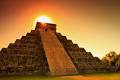
Ortman noticed that the variables used in these equations, such as cost of moving around, the size of the settled area, the population, and the benefits of people interacting, did not depend on any particular modern technology.
“I realized that if these models are adequate for explaining what’s going on in contemporary cities, they should apply to any settlements in any society,” he said. “So if these models are on the right track, they should apply to ancient societies too.”
To test his idea, Ortman used data that had been collected in the 1960s about 1,500 settlements in central Mexico that spanned from 1,150 years B.C. through the Aztec period, which ended about 500 years ago. The data included the number of dwellings the archaeologists were able to identify, the total settled area and the density of pottery fragments scattered on the surface. Taken together, these artifacts give an indication of the total population numbers and settlement density of the ancient sites.
“We started analyzing the data in the ways we were thinking about with modern cities, and it showed that the models worked,” Ortman said.
The discovery that ancient and modern settlements may develop in similar and predictable ways has implications both for archaeologists and people studying today’s urban areas. For example, it’s common for archaeologists to assume that population density is constant, no matter how large the settlement area, when estimating the population of ancient cities. The new equations could offer a way for archaeologists to get a more accurate head count, by incorporating the idea that population density tends to grow as total area increases.
In the future, the equations may also guide archaeologists in getting an idea of what they’re likely to find within a given settlement based on its size, such as the miles of roads and pathways. The equations could also guide expectations about the number of different activities that took place in a settlement and the division of labor.
“There should be a relationship between the population of settlements and the productivity of labor,” Ortman said. “So, for example, we would expect larger social networks to be able to produce more public monuments per capita than smaller settlements.”
The findings of the new study may also be useful to studies of modern societies. Because ancient settlements were typically less complex than today’s cities, they offer a simple “model system” for testing the equations devised to explain modern cities.
“The archaeological record actually provides surprisingly clear tests of these models, and in some cases it’s actually much harder to collect comparable data from contemporary cities,” Ortman said.
Other co-authors of the study include Andrew Cabaniss of Santa Fe Institute and the University of North Carolina Chapel Hill and Jennie Sturm of the University of New Mexico.
The study is available at http://dx.plos.org/10.1371/journal.pone.0087902.
-CU-
Jan 9th
University of Colorado Boulder space weather experts say a powerful solar storm may cause the aurora borealis to light up as far south as Colorado and New Mexico in the coming nights.
http://youtu.be/Ip2ZGND1I9Q
Aurora borealis may dip into state
tonight, say CU-Boulder experts
Daniel Baker, director of CU-Boulder’s Laboratory for Atmospheric and Space Physics, said space weather forecasts indicate there is a good chance a coronal mass ejection tied to a large solar flare from the sun Tuesday may impact Earth today, hitting the planet’s outer magnetic shield and causing spectacular light displays tonight and perhaps tomorrow night. National Oceanic and Atmospheric Administration experts have estimated there is a 90 percent chance a coronal mass ejection will hit Earth today.

The aurora borealis could reach as far as New Mexico, last 4-5 nihjts
“The aurora borealis, or ‘false dawn of the north,’ are brilliant dancing lights in the night sky caused by intense interactions of energetic electrons with the thin gases in Earth’s upper atmosphere,” said Baker. “The aurora are most commonly seen in Alaska, northern Canada and Scandinavia when the sun sends out powerful bursts of energy that can strike Earth’s protective outer magnetic shield called the magnetosphere,” he said.
“The strong solar winds associated with the storm events generate strong electric currents when they blow by the Earth’s magnetosphere,” said LASP Research Associate Bill Peterson. “These currents become unstable and drive processes in the magnetosphere that accelerate electrons down magnetic field lines where they hit the atmosphere over the poles.”
“One can think of aurora in some ways as if the Earth’s atmosphere is a giant TV screen and the magnetosphere generates intense beams of electrons that blast down along magnetic field lines to produce the red and green light picture show,” said Baker. “If the sun produces extremely powerful energy outbursts, the aurora can move to much lower latitudes than normal and then one can see the fantastic light displays in the lower 48 states, even as low in latitude as Colorado and New Mexico.”
According to Peterson, geophysicists have been measuring magnetic activity – essentially “wiggles” on instruments measuring Earth’s magnetic field – for over a century. The scientists have come up with a planetary magnetic index known as KP, ranging from 0 (quiet) to 9 (very active).
“The aurora is typically seen in Canada for KP less than 4,” Peterson said. “When the KP is 9, auroras can sometimes be seen as far south as Mexico City. Auroras are seen in Colorado when the KP is about 7.”
Peterson suggested those interested in seeing the northern lights or want to report sightings visithttp://www.aurorasaurus.org, a website called “Aurorasaurus” and led by the Los Alamos National Laboratory in New Mexico. The site is designed as a real-time map of confirmed aurora sightings and includes a place for citizen-scientists who want to participate to report aurora sightings in their own neighborhoods.
For additional information visit NOAA’s Space Weather Prediction Center at http://www.swpc.noaa.gov. For more information on LASP visit http://lasp.colorado.edu/home/.
-CU-
Mar 27th
A new look at conditions after a Manhattan-sized asteroid slammed into a region of Mexico in the dinosaur days indicates the event could have triggered a global firestorm that would have burned every twig, bush and tree on Earth and led to the extinction of 80 percent of all Earth’s species, says a new University of Colorado Boulder study.
Led by Douglas Robertson of the Cooperative Institute for Research in Environmental Sciences, or CIRES, the team used models that show the collision would have vaporized huge amounts of rock that were then blown high above Earth’s atmosphere. The re-entering ejected material would have heated the upper atmosphere enough to glow red for several hours at roughly 2,700 degrees Fahrenheit — about the temperature of an oven broiler element — killing every living thing not sheltered underground or underwater.

An artist’s rendition of the asteroid air strike 66 million years ago
The CU-led team developed an alternate explanation for the fact that there is little charcoal found at the Cretaceous-Paleogene, or K-Pg, boundary some 66 million years ago when the asteroid struck Earth and the cataclysmic fires are believed to have occurred. The CU researchers found that similar studies had corrected their data for changing sedimentation rates. When the charcoal data were corrected for the same changing sedimentation rates they show an excess of charcoal, not a deficiency, Robertson said.
“Our data show the conditions back then are consistent with widespread fires across the planet,” said Robertson, a research scientist at CIRES, which is a joint institute of CU-Boulder and the National Oceanic and Atmospheric Administration. “Those conditions resulted in 100 percent extinction rates for about 80 percent of all life on Earth.”
A paper on the subject was published online this week in the Journal of Geophysical Research-Biogeosciences, a publication of the American Geophysical Union. Co-authors on the study include CIRES Interim Director William Lewis, CU Professor Brian Toon of the atmospheric and oceanic sciences department and the Laboratory for Atmospheric and Space Physics and Peter Sheehan of the Milwaukee Public Museum in Wisconsin.
Geological evidence indicates the asteroid collided with Earth about 66 million years ago and carved the Chicxulub crater in Mexico’s Yucatan Peninsula that is more than 110 miles in diameter. In 2010, experts from 33 institutions worldwide issued a report that concluded the impact at Chicxulub triggered mass extinctions, including dinosaurs, at the K-Pg boundary.
The conditions leading to the global firestorm were set up by the vaporization of rock following the impact, which condensed into sand-grain-sized spheres as they rose above the atmosphere. As the ejected material re-entered Earth’s atmosphere, it dumped enough heat in the upper atmosphere to trigger an infrared “heat pulse” so hot it caused the sky to glow red for several hours, even though part of the radiation was blocked from Earth by the falling material, he said.
But there was enough infrared radiation from the upper atmosphere that reached Earth’s surface to create searing conditions that likely ignited tinder, including dead leaves and pine needles. If a person was on Earth back then, it would have been like sitting in a broiler oven for two or three hours, said Robertson.
The amount of energy created by the infrared radiation the day of the asteroid-Earth collision is mind-boggling, said Robertson. “It’s likely that the total amount of infrared heat was equal to a 1 megaton bomb exploding every four miles over the entire Earth.”
A 1-megaton hydrogen bomb has about the same explosive power as 80 Hiroshima-type nuclear bombs, he said. The asteroid-Earth collision is thought to have generated about 100 million megatons of energy, said Robertson.
Some researchers have suggested that a layer of soot found at the K-Pg boundary layer roughly 66 million years ago was created by the impact itself. But Robertson and his colleagues calculated that the amount of soot was too high to have been created during the massive impact event and was consistent with the amount that would be expected from global fires.
[includeme src=”http://c1n.tv/boulder/media/bouldersponsors.html” frameborder=”0″ width=”670″ height=”300″]