








May 1st
 The widely held notion that Neanderthals were dimwitted and that their inferior intelligence allowed them to be driven to extinction by the much brighter ancestors of modern humans is not supported by scientific evidence, according to a researcher at the University of Colorado Boulder.
Neanderthals thrived in a large swath of Europe and Asia between about 350,000 and 40,000 years ago. They disappeared after our ancestors, a group referred to as “anatomically modern humans,” crossed into Europe from Africa.
In the past, some researchers have tried to explain the demise of the Neanderthals by suggesting that the newcomers were superior to Neanderthals in key ways, including their ability to hunt, communicate, innovate and adapt to different environments.
But in an extensive review of recent Neanderthal research, CU-Boulder researcher Paola Villa and co-author Wil Roebroeks, an archaeologist at Leiden University in the Netherlands, make the case that the available evidence does not support the opinion that Neanderthals were less advanced than anatomically modern humans. Their paper was published today in the journal PLOS ONE.
Villa and Roebroeks scrutinized nearly a dozen common explanations for Neanderthal extinction that rely largely on the notion that the Neanderthals were inferior to anatomically modern humans. These include the hypotheses that Neanderthals did not use complex, symbolic communication; that they were less efficient hunters who had inferior weapons; and that they had a narrow diet that put them at a competitive disadvantage to anatomically modern humans, who ate a broad range of things.
The researchers found that none of the hypotheses were supported by the available research. For example, evidence from multiple archaeological sites in Europe suggests that Neanderthals hunted as a group, using the landscape to aid them.
Researchers have shown that Neanderthals likely herded hundreds of bison to their death by steering them into a sinkhole in southwestern France. At another site used by Neanderthals, this one in the Channel Islands, fossilized remains of 18 mammoths and five woolly rhinoceroses were discovered at the base of a deep ravine. These findings imply that Neanderthals could plan ahead, communicate as a group and make efficient use of their surroundings, the authors said.
Other archaeological evidence unearthed at Neanderthal sites provides reason to believe that Neanderthals did in fact have a diverse diet. Microfossils found in Neanderthal teeth and food remains left behind at cooking sites indicate that they may have eaten wild peas, acorns, pistachios, grass seeds, wild olives, pine nuts and date palms depending on what was locally available.
Additionally, researchers have found ochre, a kind of earth pigment, at sites inhabited by Neanderthals, which may have been used for body painting. Ornaments have also been collected at Neanderthal sites. Taken together, these findings suggest that Neanderthals had cultural rituals and symbolic communication.
Source: CU Boulder

Mar 20th
But this time he will not be riding in the familiar confines of a NASA space shuttle — the fleet was retired in 2011 — but in a capsule atop a Soyuz TMA-12 rocket launching from the Baikonur Cosmodrome in Kazakhstan. Not only will he blast off from there, he is slated to land in the capsule, which is somewhat similar to a NASA Apollo capsule, on the steppe of Kazakhstan in September after spending roughly six months in space.

Former CU student Steve Swanson eads to the International Space Station for the third time.
Swanson, who earned a bachelor’s degree in engineering physics from CU-Boulder in 1983, will serve as flight engineer for Expedition 39, which already will be underway on the ISS when he arrives. In late May, Swanson, who considers Steamboat Springs, Colo., his hometown, will become space station commander as Expedition 40 begins.
Swanson will be launched to the ISS along with cosmonauts Alexander Skvortsov and Oleg Artemyev of the Russian Federal Space Agency.
“We’ve trained extensively and I’m confident I can do all of the tasks assigned to me on the space station,” Swanson said. “The difficult part is being away from my family and friends for a long period. I’ll miss them, but at the same time we will be very busy up there, which makes the time pass quickly.”
The astronaut crew will be involved in dozens of research experiments in the low gravity of the ISS, including efforts related to protein crystal growth, capillary blood flow, gravity sensing by plants and muscle and bone loss changes in space.
As part of his duties, Swanson will operate hardware developed by BioServe Space Technologies located in CU-Boulder’s aerospace engineering department to conduct two experiments on the space station, both being launched later this year. One led by Dr. Timothy Hammond of the Department of Veterans Affairs will use a yeast-based assay system to evaluate known and novel anti-cancer drug therapies in the low gravity of space. A second led by Professor Cheryl Nickerson of Arizona State University will evaluate host-pathogen interactions to better understand the risk of in-flight infections by space explorers during long-term missions.
Swanson previously flew on the STS-17 mission aboard the space shuttle Atlantis to the ISS in June 2007, then flew again on the STS-19 mission aboard Discovery in March 2009. Swanson spacewalked for more than 26 hours during the two missions and is tentatively slated for two more spacewalks during Expedition 39 and Expedition 40.
What does Swanson, whose two shuttle landings were on a smooth NASA runway in Florida, think about drifting by parachute in the Soyuz space capsule on the way from the space station back to Earth, eventually banging onto the ground in Kazakhstan? “I know this landing will be much more wild and exciting than a shuttle landing,” he said. “It is going to be a very different experience, and I’m looking forward to it.”
Swanson will be packing several CU mementos, including a T-shirt, a flag and a small piece of sandstone from the engineering center that has been engraved with a picture of Ralphie the Buffalo and an image of the International Space Station.
What does he recall about his time at CU-Boulder? “I remember waking up and seeing the mountains right there,” he said. “It was a beautiful thing, and helped me get going every day. I really liked CU-Boulder — it is a good school, with good professors — and I love to ski, I love to hike. I like the culture.”
His favorite times on the space station? “One of the best things is when you have a moment to yourself where you can just look out the window,” he said. Swanson also said he will spend what little free time he has emailing with family and friends back on Earth, blogging about his space station experiences and hopefully participating in a Google Hangout, sharing messages and photos and video-chatting with CU-Boulder students.
Eighteen CU-Boulder astronaut-affiliates have flown 47 NASA space missions beginning with Scott Carpenter in 1962.
Former NASA astronaut Jim Voss, who received his master’s degree in aerospace engineering sciences from CU-Boulder in 1974, currently is a CU-Boulder Scholar in Residence. Former NASA astronaut Joe Tanner currently is a senior instructor in aerospace engineering.
To watch a video of Swanson talking about his NASA experiences and his passion for Colorado’s outdoors visit http://www.youtube.com/watch?v=KU53X7O7z7w.
-CU-

Mar 7th
Release Date: 02/28/2014
Contact Information: Hanady Kader, EPA Public Affairs, 206-553-0454, kader.hanady@epa.gov
Agency action begins process to prevent damage to world’s largest sockeye salmon fishery
(Washington, D.C.—Feb. 28, 2014) The U.S. Environmental Protection Agency is initiating a process under the Clean Water Act to identify appropriate options to protect the world’s largest sockeye salmon fishery in Bristol Bay, Alaska from the potentially destructive impacts of the proposed Pebble Mine. The Pebble Mine has the potential to be one of the largest open pit copper mines ever developed and could threaten a salmon resource rare in its quality and productivity. During this process, the U.S. Army Corps of Engineers cannot approve a permit for the mine.
This action, requested by EPA Administrator Gina McCarthy, reflects the unique nature of the Bristol Bay watershed as one of the world’s last prolific wild salmon resources and the threat posed by the Pebble deposit, a mine unprecedented in scope and scale. It does not reflect an EPA policy change in mine permitting.
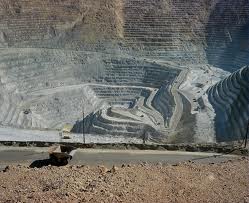
The Pebble Mine would be three times as large as the Kennecot mine pictured above
“Extensive scientific study has given us ample reason to believe that the Pebble Mine would likely have significant and irreversible negative impacts on the Bristol Bay watershed and its abundant salmon fisheries,” said EPA Administrator Gina McCarthy. “It’s why EPA is taking this step forward in our effort to ensure protection for the world’s most productive salmon fishery from the risks it faces from what could be one of the largest open pit mines on earth. This process is not something the Agency does very often, but Bristol Bay is an extraordinary and unique resource.”
The EPA is basing its action on available information, including data collected as a part of the agency’s Bristol Bay ecological risk assessment and mine plans submitted to the Securities and Exchange Commission. Today, Dennis McLerran, EPA Regional Administrator for EPA Region 10, sent letters to the U.S. Army Corps of Engineers, the State of Alaska, and the Pebble Partnership initiating action under EPA’s Clean Water Act Section 404(c) authorities.
“Bristol Bay is an extraordinary natural resource, home to some of the most abundant salmon producing rivers in the world. The area provides millions of dollars in jobs and food resources for Alaska Native Villages and commercial fishermen,” McLerran said. “The science EPA reviewed paints a clear picture: Large-scale copper mining of the Pebble deposit would likely result in significant and irreversible harm to the salmon and the people and industries that rely on them.”
Today’s action follows the January 2014 release of EPA’s “Assessment of Potential Mining Impacts on Salmon Ecosystems of Bristol Bay, Alaska,” a study that documents the significant ecological resources of the region and the potentially destructive impacts to salmon and other fish from potential large-scale copper mining of the Pebble Deposit. The assessment indicates that the proposed Pebble Mine would likely cause irreversible destruction of streams that support salmon and other important fish species, as well as extensive areas of wetlands, ponds and lakes.
In 2010, several Bristol Bay Alaska Native tribes requested that EPA take action under Clean Water Act Section 404(c) to protect the Bristol Bay watershed and salmon resources from development of the proposed Pebble Mine, a venture backed by Northern Dynasty Minerals. The Bristol Bay watershed is home to 31 Alaska Native Villages. Residents of the area depend on salmon as a major food resource and for their economic livelihood, with nearly all residents participating in subsistence fishing.
Bristol Bay produces nearly 50 percent of the world’s wild sockeye salmon with runs averaging 37.5 million fish each year. The salmon runs are highly productive due in large part to the exceptional water quality in streams and wetlands, which provide valuable salmon habitat.
The Bristol Bay ecosystem generates hundreds of millions of dollars in economic activity and provides employment for over 14,000 full and part-time workers. The region supports all five species of Pacific salmon found in North America: sockeye, coho, Chinook, chum, and pink. In addition, it is home to more than 20 other fish species, 190 bird species, and more than 40 terrestrial mammal species, including bears, moose, and caribou.
Based on information provided by The Pebble Partnership and Northern Dynasty Minerals, mining the Pebble deposit may involve excavation of a pit up to one mile deep and over 2.5 miles wide — the largest open pit ever constructed in North America. Disposal of mining waste may require construction of three or more massive earthen tailings dams as high as 650 feet. The Pebble deposit is located at the headwaters of Nushagak and Kvichak rivers, which produce about half of the sockeye salmon in Bristol Bay.
The objective of the Clean Water Act is to restore and maintain the chemical, physical, and biological integrity of the nation’s waters. The Act emphasizes protecting uses of the nation’s waterways, including fishing.
The Clean Water Act generally requires a permit under Section 404 from the U.S. Army Corps of Engineers before any person places dredge or fill material into wetlands, lakes and streams. Mining operations typically involve such activities and must obtain Clean Water Act Section 404 permits. Section 404 directs EPA to develop the environmental criteria the Army Corps uses to make permit decisions. It also authorizes EPA to prohibit or restrict fill activities if EPA determines such actions would have unacceptable adverse effects on fishery areas.
The steps in the Clean Water Act Section 404(c) review process are:
Based on input EPA receives during any one of these steps, the agency could decide that further review under Section 404(c) is not necessary.
Now that the 404(c) process has been initiated, the Army Corps cannot issue a permit for fill in wetlands or streams associated with mining the Pebble deposit until EPA completes the 404(c) review process.
EPA has received over 850,000 requests from citizens, tribes, Alaska Native corporations, commercial and sport fisherman, jewelry companies, seafood processors, restaurant owners, chefs, conservation organizations, members of the faith community, sport recreation business owners, elected officials and others asking EPA to take action to protect Bristol Bay.