









Mar 11th
by JACQUELINE MARCUS FOR BUZZFLASH AT TRUTHOUT
It’s time for the public to start calling 19th century barbaric fossil fuels what it is: Energy of Mass Extinction. Dirty energy companies, including nuclear power plants, have been owned by a few rich white families from the start, which is why production of energy has remained in the Dark Ages even though clean renewable energy could have lit up the world easily, cheaply and without pollution twenty years ago. Given the latest advances in green energy technology, there’s absolutely no excuse for not legislating rapid shifts to clean energy by 2020.
Instead, world leaders, primarily the US government, not only serve as “barriers” to the advancement of green energy, they’re the fossil fuel industry’s sleaziest salesmen on earth: Big Oil pays for their seats on the Hill for the sole purpose of selling Energy of Mass Extinction to world markets. Oil executives are given an open door invitation to the White House any time and day of the week.
By contrast, lawyers that represent the public’s welfare and our environment are not welcomed, or they are put on a long waiting list. In short, the oil oligarchs operate from the White House where the polluters meet and draw up their plans. Judges are also owned by the oil firms. For example, read Buzzflash editor at Truthout Mark Karlin’s recent commentary about a federal judge that blocked U.S. courts from being used to collect a $9 billion Ecuadorean judgment against Chevron for turning a beautiful rainforest into a putrid toxic waste dump Thanks to a thoroughly corrupt US government, another victory for Chevron’s oil tyrants who don’t have to clean up the toxic sludge they leave behind after they’ve contaminated everything in sight for Energy of Mass Extinction.
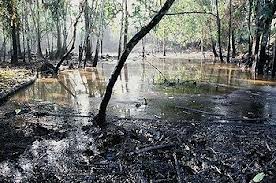
A New York judge ruled against a Bolivian lawsuit seeking $9 billion in damages for destruction of the rainforest.
In a statement, Chevron Corp. called the decision “a resounding victory for Chevron and our stockholders” and said any court that respects the rule of law will find the Ecuadorean judgment “illegitimate and unenforceable.”
In order to understand Obama’s plans for Energy of Mass Extinction, it’s worth reading two articles that appeared in the Rolling Stone: How the U.S. Exports Global Warming by Tim Dickinson. While Obama talks about shifting to a clean, green future, behind closed doors, he and his rich oil friends are selling tar-sands oil, black gunk refined to crude known as petroleum coke, which is denser and dirtier than burning coal—to world markets, mostly to China and Asian markets because it’s cheap fuel.
Too bad China won’t tell Obama to take his filthy tar-sands and shove it you know where, and that they’ll meet their energy demands with their advanced solar and wind technologies. But unfortunately, they’re buying it. And as long as there’s a demand, we will be doomed by these horrific decisions made by world leaders. Incidentally, “Hillary Clinton is even more supportive of the dirty-energy trade than the Obama White House.”
The second piece is Matt Taibbi’s The Vampire Squid Strikes Again. Thanks to deregulation going back to the Glass-Steagall Act under President Clinton, accelerated by Republican, Phil Gramm, banks have gone beyond financing dirty fossil fuel industries: they’re buying everything associated with the production of Energy of Mass Extinction for big profits.
When you read these two pieces together, you get a clear understanding of how oil firms, Wall St and the US government are buying and selling Energy of Mass Extinction in a blinding wheel of addiction to money while the earth is going up in flames. These people wouldn’t know a Redwood from a Palm tree. They’re completely divorced from nature. They are exactly what T.S. Eliot meant by the Hollow Men.
Meanwhile, in Washington D.C. hundreds of students are being arrested in front of the White House to protest against the Keystone Tar Sands Pipeline. Although these kids stepped over the line deliberately to get arrested for the sake of drawing attention to tar-sands Energy of Mass Extinction, to my mind, they were arrested to protect the oil industry.
While these kids are going to jail for trying to save a beautiful planet that is doomed from man-made pollution, the oil criminals continue to poison our drinking water, oceans, rivers, lands, and our air at mass levels of destruction. Are they getting arrested? No, they’re being wined and dined at the White House. As for the oil-owned media, as Buzzflash editor, Mark Karlin, pointed out, a huge, oil-funded PR campaign has been launched to push Obama’s approval of the northern Keystone leg from Alberta, Canada to the southern Keystone pipeline for delivery to the Gulf where it will be sold to China and Asian markets.
For example, it was disconcerting to see that HuffingtonPost Green published Warren Buffet’s cheerleading article for the Keystone pipeline. It’s one thing to post it in the business section, but to promote Buffet’s big push for the worst carbon emitting pollution on earth in the environmental section seemed terribly hypocritical at HuffPost Green. There’s one significant point that Buffet failed to mention in his article: that he plans to profit from his investment in the Keystone tar-sands pipeline. That’s how PR works: convince the public that oil (tar-sands) is good for them, when in fact, it only benefits a few billionaires like Buffet at the expense of life as we know it.
In my last Buzzflash-Truthout commentary, Who’s to Blame for Recurring Chemical & Oil Disasters, I made a reference to Elizabeth Kolbert’s new book, The Sixth Extinction. Kolbert is a staff writer at The New Yorker and also the author of Field Notes from a Catastrophe. In The Sixth Extinction, Kolbert explains how our use of fossil fuels and the effects of climate change are creating a mass extinction of the planet. “We are effectively undoing the beauty and the variety and the richness of the world which has taken tens of millions of years to reach,” said Kolbert on a NPR Fresh Air interview with Terry Gross.
That’s why it’s important for the public to call dirty energy what it is: Energy of Mass Extinction; it’s a barbaric fuel that is sucking the life and light from our Planet Earth.
Dirty Energy is the real Weapon of Mass Destruction. These ruthless monsters are not going to change their ways as long as they can profit by the billions from annihilating the earth. Therefore, we must all make an effort to stop using and buying these deadly products to the best of our abilities. That’s what’s happening in Hawaii. Residents are opting out of the grid for solar and by doing so, making it impossible for the antiquated utility company (HECO) to stay alive. Read Hawaii’s top renewable energy advocate Henry Curtis’ piece U.S. Utilities Face Impending Doom with the Rise of Cheap Solar.
—
Jacqueline Marcus is a contributing guest writer for Buzzflash at Truthout.org; she’s the editor ofForPoetry.com and EnvironmentalPress.com and author of Close to the Shore by Michigan State University Press. Her E-book, Man Cannot Live on Oil, Alone: Time to end our dependency on oil before it ends us, is available at Kindle Books.
Mar 11th
Fisher Auto stands out among other dealerships in the Denver, Colorado area for its unmatched service, honest treatment, and competitive pricing! Whether you’re looking for a sleek sports car, reliable four-door sedan, efficient hybrid, the minivan that fits your whole family, the powerful SUV that braves the fiercest mountain weather, or the truck that gives you the freedom to haul whatever you need, wherever you want, Fisher Auto in Boulder, CO has just the right vehicle for you!
 6025 Arapahoe Road
Boulder, CO 80303
855-219-2886







March 29th, 2016

July 12th, 2015

May 5th, 2014

April 15th, 2014
March 11th, 2014

Mar 10th
Boulder Police detectives have been investigating a series of thefts of high-end bicycles from the downtown area and today, March 10, 2014, formally arrested the suspect, John William Samson III (DOB 10/04/1975). Samson was arrested at the Boulder County Jail, where he has been incarcerated on separate charges.
Samson faces 34 counts of Theft, one count of Third Degree Burglary, one count of Criminal Trespass and one count of Criminal Mischief. Twenty-nine of the charges are felonies.

Investigators believe Samson is responsible for the thefts of 43 bicycles from May 2013 until September 2013. The bikes are worth a total of approximately $147,000.00. The bicycles range in price from $700.00 to $9,000.00 each.
The majority of the thefts took place in the downtown business area during daylight hours. Most of the bikes were locked, either to bike racks or on vehicle racks. None of the stolen bikes have been recovered, and they have not shown up in area pawn shops.
Several bicycles were stolen from the campus of Boulder High School, including five bikes belonging to the Boulder High School’s mountain bike team. Those bicycles had been stored in a locked trailer and were taken during the Boulder flood.
Victims include local residents, people travelling through Colorado on vacation and at least one victim who had driven to Boulder for a bike competition, only to find his bicycle stolen the day before he was to compete. Victims are juveniles, students, professionals, a professor and an out-of-state fire fighter.
Brands of the stolen bikes include: Yeti, Santa Cruz, Transition, Titus, Felt, Scott, Specialized, Kona, Gary Fisher, Trek and Klein.
Samson is currently in jail, and his bond has been set at $100,000.00. Detectives are continuing to investigate.
The Boulder Police Department has been working in partnership with the Colorado Department of Corrections, which provided critical information and timely assistance during our investigation.
Anyone with information about these thefts is asked to contact Detective Craig Beckjord at 303-441-3336. Those who have information but wish to remain anonymous may contact the Northern Colorado Crime Stoppers at 1-800-222-TIPS (8477) or 1-800-444-3776. Tips can also be submitted through the Crime Stoppers website atwww.crimeshurt.com. Those submitting tips through Crime Stoppers that lead to the arrest and filing of charges on a suspect(s) may be eligible for a cash reward of up to $1,000 from Crime Stoppers.
— CITY–