







Oct 31st
For too long, our Rep in CD 2 has downplayed their connections to Boulder even though Boulder County might make up 55% of the voters. We now have a Congressman who is proud to be from Boulder and to represent our values. Folks here should appreciate being embraced rather than shrugged and support Polis at the polls. Jared Polis grew up in the City of Boulder and was extremely well known in town personally even before running for Congress.
Jared Polis formed his core values protesting Rocky Flats with his parents while growing up. Given his stated priority for the morality of stopping an ever escalating nuclear arms race, there is a reasonable expectation that he cares about the Nuclear Non Proliferation Treaty (NPT) more than most Democratic Reps. The NPT has been the cornerstone of foreign policy for many nations, not just the USA and Russia. The NPT obliges its signatories to work in good faith toward a nuclear weapon free world as well as guaranteeing the right to nuclear energy and uranium enrichment. As the President has stated, that includes Iran. While knowing and publicly stating that Iran is not attempting to produce a nuclear weapon and simultaneously beating the drums of war over the guaranteed right to enrich uranium for peaceful purposes, elements in the USA and Israel could be more interested in undermining the NPT. The nuclear weapons industrial complex is very powerful and wants its profits back. We need a Congressman who can stand up to these entrenched interests. A strong NPT makes the world a safer place for all nations.
Education has been a cornerstone of Jared’s priorities for a long time as well. He was on the Colorado School Board for 6 years and founded five schools. His work to get more kids headed to college should serve the University of Colorado and its role in Boulder well. He believes that education is the single most meaningful investment America can make in its economic future and in its people. Having the University here in town puts the role of the educational system into great prominence locally.
Jared Polis also prides himself on being a champion for environmental issues which has been a CD 2 legacy.
Scott Hatfield has been a member of the Central Committee of the Colorado Democratic Party and the Executive Committee of the Boulder Democratic Party since 1996.
Mar 5th
Several former high-level military and intelligence officials took out a full page ad in Monday’s Washington Post urging President Obama to resist pressure to attack Iran nuclear program.
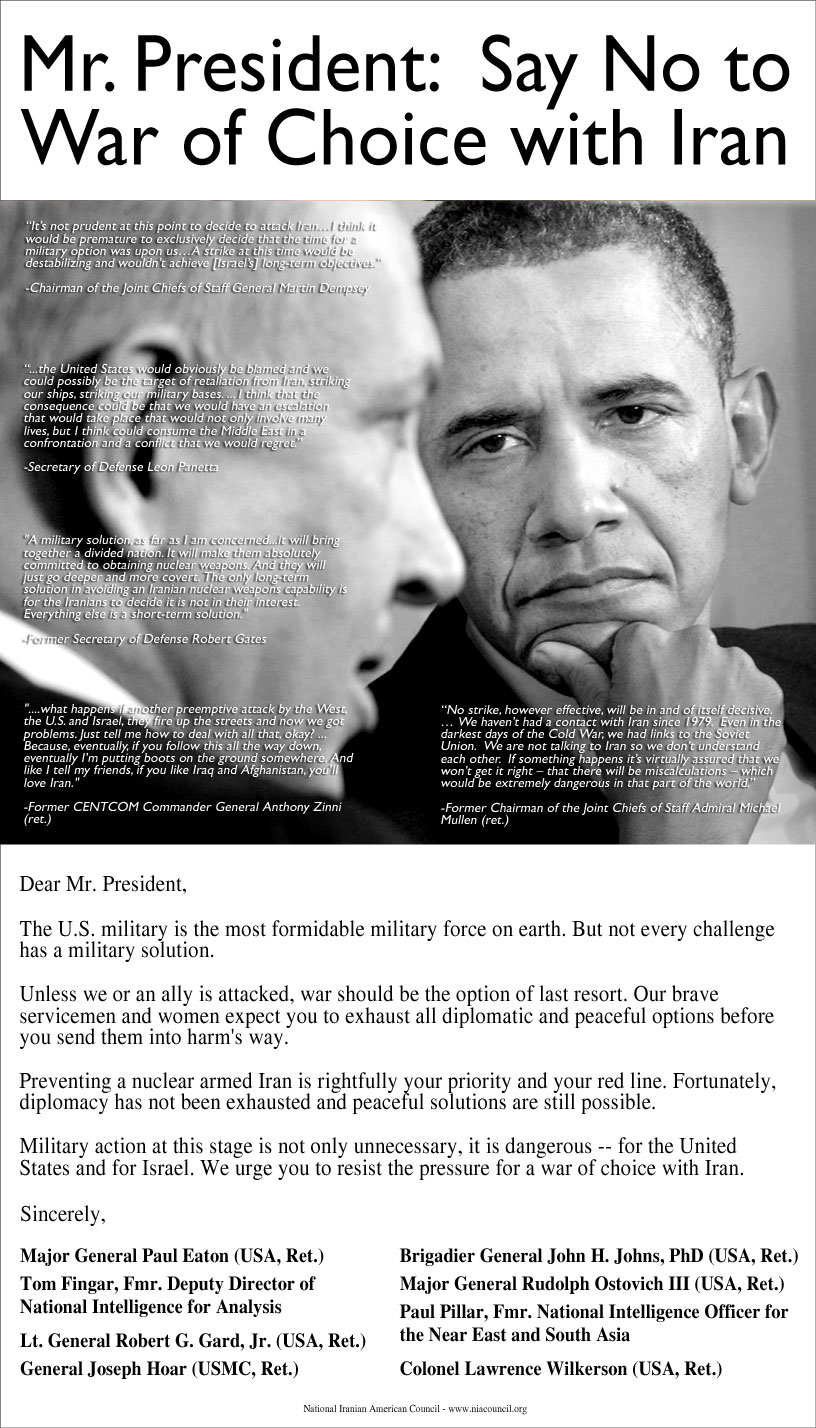 The letter retired Army Maj. Gen. Paul Eaton, retired Army Lt. Gen. Robert G. Gard Jr., retired Marine Gen. Joseph Hoar, retired Army Brig. Gen. John H. Johns, retired Army Maj. Gen. Rudolph Ostovich III, former deputy director of National Intelligence for analysis Thomas Fingar, former CIA national intelligence officer Paul Pillar, and retired Army Col. Lawrence Wilkerson.
The page is headlined “Mr. President: Say No to a War of Choice with Iran,” and is sponsored by the National Iranian American Council, a non-partisan, non-profit organization headquartered in Washington. The letter states that “not every challenge has a military solution” and “unless we or an ally is attacked, war should be the option of last resort.
The ad also features quotations by current and former senior military and intelligence officials explaining why attacking Iran is the wrong move. Those include Chairman of the Joint Chiefs of Staff Gen. Martin Dempsey, Secretary of Defense Leon Panetta, former Secretary of Defense Robert Gates, former CENTCOM Commander Gen. Anthony Zinni, and former Chairman of the Joint Chiefs of Staff Admiral Michael Mullen.
Feb 23rd
Here’s a crash course on how one of “our” – monarchic – dictators treats his own people during the great 2011 Arab revolt.
The king of Bahrain, Hamad al-Khalifa, has blood on his hands after his mercenary security forces – Pakistani, Indian, Syrian and Jordanian – with no previous warning, attacked sleeping, peaceful protesters at 3 am on Thursday at the Pearl roundabout, the tiny Gulf country’s version of Cairo’s Tahrir Square.
In the brutal crackdown, at least five people have been killed – including a young child – and 2,000 injured, some by gunshots, two of these in critical condition. Riot police targeted doctors and medics and prevented ambulances and blood donors from reaching the Pearl roundabout. A doctor at Salmaniya hospital told al-Jazeera there was a refrigerated truck outside the hospital, which he fears the army has used to remove more dead bodies.
The resourceful Maryama Alkawaka of the Bahrain Center for Human Rights was there; “It was very violent, [the police] were not showing any mercy.” An avalanche of tweets from Bahrainis denounced an “Israeli-style” sneak attack and shoot-to-kill approach. And many have denounced al-Jazeera for not having kept a live satellite link as it had in Cairo, and for implying that this was only a Shi’ite protest. The Pearl roundabout is now surrounded by nearly 100 tanks at every entrance and exit. Downtown Manama has been turned into a ghost city.
The Shi’ite opposition described it as “real terrorism”. Reem Khalifa, senor editor at the opposition newspaper al-Wasat, said, “The regime forces just came and massacred a crowd of people as they slept.” They had been “chanting together, shouting ‘neither Sunni nor Shi’ite but Bahraini’. We have not seen this before. And this is what annoyed the government agents the most – they are always trying to divide the people … And now the regime is spreading lies about me and other journalists who are trying to say what is happening.”
Khalifa had the courage to stand up and harshly confront Bahrain’s foreign minister at a press conference, totally debunking his version of events (he called the deaths “regrettable” but insisted protesters were sectarian, and armed).
The Gulf Cooperation Council – the scandalously wealthy club of local kingdoms which holds over US$1 trillion stashed away in foreign reserves and almost 50% of the world’s proven oil reserves still underground – issued, what else, a bland statement supporting Bahrain.
Kill them, but with a velvet glove
Is Washington remotely outraged by all this? The record speaks for itself. United States Secretary of State Hillary Clinton expressed “deep concern”, according to the State Department, and “urged restraint”. The Pentagon said Bahrain was “an important partner”; later Secretary of Defense Robert Gates called Bahrain’s Crown Prince Salman – certainly to make sure everything was dandy with the US Navy’s 5th Fleet and its 2,250 personnel housed in an isolated compound inside 24 hectares in the center of Manama.
Even the New York Times was forced to acknowledge that US President Barack Obama had “yet to issue the blunt public criticism of Bahrain’s rulers that he eventually leveled against President Hosni Mubarak of Egypt – or that he has repeatedly aimed at the mullahs in Iran”. But he can’t; after all, Bahrain’s I-shot-my-people king is another usual suspect, a “pillar of the American security architecture in the Middle East”, and “a staunch ally of Washington in its showdown with Iran’s Shi’ite theocracy”.
Under these strategic circumstances, it’s hard to dismiss Lebanese political scientist and blogger at the Angry Arab website As’ad AbuKhalil, when he stresses, “The US had to plot the repression of Bahrain to appease Saudi Arabia and other Arab tyrants who were mad at Obama for not defending Mubarak to the every end.”
Incidentally, Saudi Arabia’s prince Talal Bin Abdulaziz – father of the billionaire darling of the West prince Al Waleed bin Talal – told the BBC there’s a danger the protests in Bahrain could spill into Saudi Arabia.
It’s never enough to stress Bahrain is all about Iran vs Saudi Arabia (see All about the Pearl roundabout Asia Times Online, February 18).
The US naval base in Manama translates as a cop on the (Persian Gulf) beat. Moreover, 15% of Saudi Arabia’s population is Shi’ite, living in the eastern provinces, where the oil is. That makes it very hard for Bahrainis – Shi’ite and even Sunni – to threaten the ruling, Sunni, al-Khalifa dynasty, as the House of Saud will immediately rush in with all sorts of logistical and military support.
Moreover, Saudi Arabia has huge leverage over Bahrain’s oil, which comes from the shared Abu Saafa oilfield, explored by Saudi Aramco and shared with a Bahraini refiner.
Bahrain is far from swimming in oil. According to International Monetary Fund figures, in 2010 Saudi Arabia produced roughly 8.5 million barrels of oil a day; the United Arab Emirates 2.4 million barrels; Kuwait 2.3 million barrels; and Bahrain only 200,000 barrels.
According to Moody’s, to balance its budget the Bahrain government needs oil at $80 a barrel, “one of the highest budgetary ‘break-even’ points in the region”, says the Financial Times. As a Barclays Capital report puts it with typical corporate contortionism, “The announcements of street protests, concessions by the government at the cost of a deteriorating fiscal position and simmering political tensions have created a backdrop that has clearly caused investors to view Bahrain with increased caution.”
So if protesters really want to hit the al-Khalifa where it hurts, they should aim at the nexus oil business/financial sector. It will be an extraordinary uphill struggle against a nasty police state crammed with mercenaries – especially Jordanian military consultants (the “master torturer” of the Mukhabarat is a Jordanian) and now also counting on “help” from Saudi tanks and troops. Moreover, the riot police and special forces don’t speak the local dialect, and in the case of Balochis from Pakistan, don’t even speak Arabic.
Prospects are bleak. The inside dope in Manama is of a split within the royal family. The dreaded, sectarian Khalid bin Ahmed, responsible for the policy of naturalizing “imported” Sunnis to alter the demographic balance and dilute even more the voting rights of the indigenous Shi’ite population, would be on one side; and the king plus Crown Prince Salman (Gates’ pal) would be on the other. The king may be losing control. And in this case Saudi Arabia would be lobbying for bin Ahmed to take over and get one of the king’s sons, Nasir Bin Hamed to be crown prince. This does make sense if seen under the angle of the brutal crackdown.
Time to cross the bridge
What Bahrain’s Shi’ites can certainly accomplish is to inspire Shi’ites in Saudi Arabia in terms of a long fight for greater social, economic and religious equality. It’s wishful thinking to bet on the House of Saud reforming itself – not while enjoying extraordinary oil wealth and maintaining a vast repression apparatus, more than enough to buy or intimidate any form of dissent.
Yet there may be reasons to dream of Saudi Arabia following the winds of new Egypt. The average age of the House of Saud trio of ruling princes is 83. Of the country’s indigenous population of 18.5 million, 47% is under 18. A medieval conception of Islam, as well as overwhelming corruption, is under increasing vigilance on YouTube, Facebook and Twitter.
The middle class is shrinking. 40% of the population actually lives under the seal of poverty, has access to virtually no education, and is in fact unemployable (90% of all employees are “imported” Sunnis). Even crossing the causeway to Manama is enough to give people ideas.
Once again, talk about an extraordinary uphill struggle – in a country with no political parties – or labor unions, or student organizations; with any sort of protests and strikes outlawed; and with members of the shura council appointed by the king.
The Arab News newspaper anyway has already warned that those winds of freedom from northern Africa may hit Saudi Arabia. And it may all revolve around youth unemployment, at an unsustainable 40%. There’s no question; the great 2011 Arab revolt will only fulfill its historic mission when it shakes the foundations of the House of Saud. Young Saudi Sunnis and Shi’ites, you have nothing to lose but your fear.
Tweet this!