







Aug 3rd
One final vote on this issue is scheduled for Aug. 16, but council has indicated this can go on the consent agenda, so no significant changes are anticipated.
The approved ballot language includes several provisions that place limitations on the authority to issue bonds and chart out clear citizen involvement and representation on an advisory board to guide future decisions. These include:
A provision that rates cannot exceed those offered by the current provider, Xcel Energy, on the date that the city purchases the system from Xcel;
Guiding principles for the municipal utility, once established, that make rate parity and the city’s commitment to lowering greenhouse gas emissions key factors in future ratemaking and operations decisions;
A commitment to a nine-member advisory board, appointed by City Council, with staggered five-year terms; the board can include up to four non-residents (to allow for involvement of business owners and employees of businesses that pay electric bills within city limits), and council will seek broad, but not rigidly defined, representation of customer classes; and lastly,
A guarantee that the city will cover taxes that would have been paid to the Boulder Valley School District as well as a mechanism to allow for the payment of similar taxes to other governmental entities.
Each of these issues is covered in the ballot language and accompanying ordinance for the first of two measures voters will be asked to consider.
The second, related question will ask voters to approve an increase in the Utility Occupation Tax that Xcel currently collects from customers. This increase is necessary to fund legal and engineering costs the city will incur while working to determine a final price to purchase Xcel’s system. The tax, which would raise up to $1.9 million a year, would last either until Dec. 13, 2017, or until the city makes a decision about whether or not to proceed with buying the system, whichever occurs first. The idea of the tax is to provide the funding for the period before the city could actually launch a utility without having to move forward on issuing bonds. This period is expected to last three to six years.
“This is an exciting time for Boulder, and it was very satisfying to see council come to some important conclusions last night,” said Mayor Susan Osborne. “The language that we expect to go before voters includes carefully thought out opportunities and limitations that address both the city’s economic and environmental objectives. Although there are still some differences of opinion on council, we are unanimous that it is time to ask voters to play their part in charting out our future.”
More details, including specific ballot language and staff memos to council, are available at http://www.boulderenergyfuture.com. A complete broadcast of the council meeting is available for viewing under http://www.bouldercolorado.gov/channel8 under the Council Archives menu item.
Aug 2nd
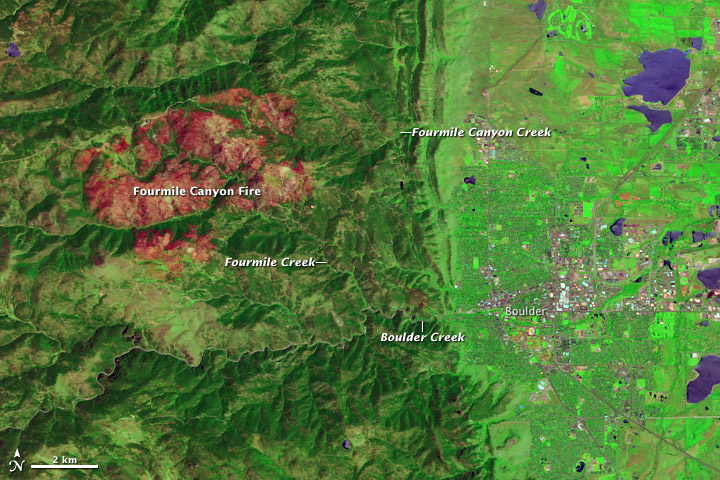
In September 2010, the Fourmile Canyon Fire broke out in the foothills west of Boulder, Colorado, scorching more than 6,000 acres (2,500 hectares) and forcing residents to evacuate. Ten months later, residents had to evacuate again, this time to flee floods. Stripped of vegetation, the slopes along Fourmile Canyon soaked up little of the water dropped by a thunderstorm. Instead, the runoff surged into local stream channels.
On June 7, 2011, the Advanced Land Imager (ALI) on NASA’s Earth Observing-1 (EO-1) satellite observed the Fourmile Canyon burn scar. The top image is made from a combination of shortwave infrared and visible light. The bottom image is natural color.
The scar is more easily detected in the false-color image, where the burned area appears in shades of red and orange. Creek valleys, which generally escaped the flames in September 2010, form winding corridors of green through the scar. To the east and southeast, the city of Boulder lies on relatively flat land.
After the fire, the U.S. Geological Survey (USGS) warned residents to prepare for the possibility of flooding, even from small rainstorms. Late on July 13, 2011, such a storm occurred. As rain fell west of Boulder, Fourmile Creek rose rapidly. In fact, at one USGS gauge, the water discharge rate skyrocketed in a matter of minutes from 10 cubic feet per second to 350 cubic feet per second. The increased water flow translated into a 4-foot (1.2-meter) surge down the creek. Smaller surges followed later that night and over the next few days.
Fourmile Creek is a tributary of Boulder Creek, which flows eastward through the city. Water levels usually peak between mid-May and early July. But thanks to the melting of an unusually heavy snowpack, water levels on Boulder Creek were especially high when the July 13 thunderstorm struck. As residents in the Fourmile burn area were ordered to evacuate low-lying homes, emergency sirens also sounded in Boulder.
By late July 2011, water levels had receded along both the Fourmile and Boulder Creeks, although water levels in both remained above normal. Colorado’s monsoon season typically lasts from about mid-July to early September, so the possibility of more flooding remains.
Because of the angle of sunlight, these images may cause an optical illusion known as relief inversion.
References
Byars, M. (2011, July 13). Heavy rains hit Fourmile, prompt evacuations along Boulder Creek. Boulder Daily Camera. Accessed July 29, 2011.
Colorado Mountain Club. Protecting Yourself from Mountain Hazards. Accessed July 29, 2011.
Colorado Water Science Center. (2011, July 13). Video From Fourmile Creek at Orodell. USGS. Accessed July 29, 2011.
Colorado’s Surface Water Conditions. (2011, July 29). Boulder Creek at Boulder, Colorado. State of Colorado. Accessed July 29, 2011.
National Water and Climate Center. (2011, July 7). Weekly Report – Snowpack/Drought Monitor Update. U.S. Department of Agriculture. Accessed July 29, 2011.
National Water Information System. (2011, July 29). USGS 06727410 Fourmile Creek at Logan Mill Road near Crisman, Colorado. USGS. Accessed July 29, 2011.
National Water Information System. (2011, July 29). USGS 06727500 Fourmile Creek at Orodell, Colorado. USGS. Accessed July 29, 2011.
News staff. (2011, July 13). Thunderstorms pound area; flood sirens sound in Boulder. The Denver Post. Accessed July 29, 2011.
Ruddy, B.C., Stevens, M.R., Verdin, K.L., and Elliott, J.G. (2010). Probability and volume of potential postwildfire debris flows in the 2010 Fourmile burn area, Boulder County, Colorado: U.S. Geological Survey Open-File Report 2010–1244. Accessed July 29, 2011.
Snider, L. (2011, June 8). Boulder Creek swells as warm weather melts snowpack. Boulder Daily Camera. Accessed July 29, 2011.
NASA Earth Observatory image created by Jesse Allen and Robert Simmon, using EO-1 ALI data provided courtesy of the NASA EO-1 team and the United States Geological Survey. Caption by Michon Scott.
Aug 1st