








Feb 15th
Husky’s backcourt unstoppable, but Buffs were in the game til the very end
BOULDER – Colorado’s Jamee Swan and Ashley Wilson hit career highpoints on Friday night, but a business-as-usual performance by Washington’s backcourt trumped them and the Buffaloes.
While Swan (25 points) and Wilson (15) were scoring career highs and Wilson was collecting her first career double-double with 10 rebounds, UW guards Kelsey Plum and Jazmine Davis were combining for 49 points to push the Huskies past the Buffs 87-80 at the Coors Events Center.
It wasn’t anything the Buffs hadn’t seen before – and they didn’t have many answers then either. In UW’s 81-71 Pac-12 Conference win last month in Seattle, they combined for 55 points, with Plum getting 35 and Davis 20.
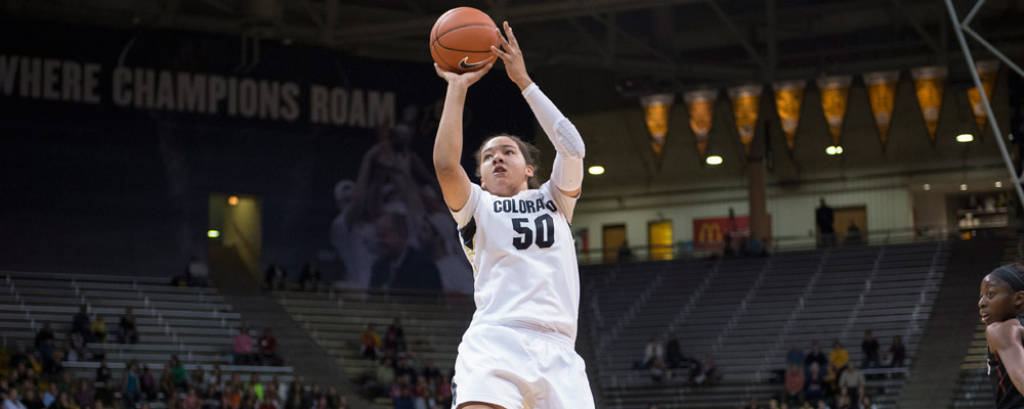
Jamie Swan lit up the scoring for Buffs with 25 points
On Friday night, Plum scored 25, Davis 24. They entered the game as the nation’s No. 2 top scoring backcourt, averaging 38.9 points.
“Washington’s two guards were outstanding . . . they torched us,” said CU coach Linda Lappe. “They pretty much did whatever they wanted to do . . . Davis carried them in first half (with 14 points), Plum came alive in the second (with 18). They were tough for us to guard.”
Still, even with Plum-Davis running mostly unchecked, the Buffs (14-10, 4-9) stayed in contention, cutting a 10-point Huskies lead to three twice in the final 1:16 but failing take the rally any further.
After tying the score at 60-60 on a Swan put-back with 8:57 remaining, a 10-0 run pushed UW ahead by 10 (70-60). CU first closed to within three (81-78) on Jen Reese’s first four points of the night, then got to within three again (83-80) on a basket by Arielle Roberson, who finished with 14 points and nine rebounds.
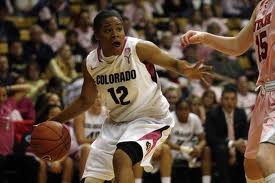
Ashley Wilson had the best game of her career
But three points back was as close as the Buffs would get, and Wilson said the game was lost by CU’s inability to “get those crucial stops, whether it was keeping them from scoring or getting a defensive rebound . . . It all comes down to the same thing: we make a push and tie the game and then we have a mental lapse where we don’t get that stop or defensive rebound. It’s been like that all conference season long.”
Lappe said scoring that many points – CU was averaging 70.2 – should have rewarded her team with a win: “Anytime we score 80, that has to be a game where we find a way to win. But it just didn’t go the right way tonight . . . you can’t give up 87 points; there are very few games that we will win that way. We just didn’t do what it took on the defensive side.”
Swann, whose previous career high was 20 against Stanford, said the Buffs lost focus late: “I think it comes down to who wants it more and it just happens that they want it a little more than us and we lose focus.”
UW coach Mike Neighbors didn’t seem surprised by Swan’s productivity. “She was on the scouting report because we recruited the heck out of that kid,” he said. “We wanted her very badly . . . she got it really going and we didn’t have a lot to answer – 25 points in 18 minutes . . . I’m just glad she had five fouls (No. 5 came with 1:30 left) or otherwise she could have had 50 (points).”
UW (14-10, 7-6) outscored CU 34-26 in the paint, outrebounded the Buffs 45-38 and converted 13 CU turnovers into 18 points. CU’s bench outscored UW’s 36-19 – mainly on Swan’s contribution before she fouled out with 1:30 to play. The Buffs hurt themselves at the free throw line, converting only 21 of 33 attempts. The Huskies shot 46.7 percent from the field (28-for-60), the Buffs 40.9 percent (27-for-66).
CU jumped to a 9-2 lead but UW recovered quickly with an 11-2 run and took its first lead on a Plum 3-pointer with 15:01 left before intermission. Davis followed with trey on the Huskies’ next possession, giving them their largest advantage (16-11) of the first half.
The first half’s last 13 minutes produced six ties and 11 lead changes before Ashley Wilson hit one of two free throws with 22.1 seconds left to put CU up 40-39 at the break.
The Huskies took a 49-43 to open the second half, getting back-to-back treys by Davis and Talia Walton, the latter hitting her triple with 16:38 left in the game. The Buffs fought back, closing to 51-50 on a 3-pointer by Lexy Kresl with just over 13 minutes remaining.
But the Huskies answered with a 6-0 run on consecutive conventional three-point plays by Plum and Chantel Osahor to open a seven-point advantage – 57-50 – with 12:19 to play.
If CU was to make a move, it would have to be soon. Ashley Wilson and Swan made two free throws each to pull the Buffs to within 57-54. After Swan scored consecutive baskets to tie the score at 60-60, the Huskies got 3-pointers from Osahor – only her second in five games – and Mercedes Wetmore and two free throws each from Katie Collier and Plum to pull ahead 70-60.
It was UW’s largest lead of the night, but a runner by Plum in the lane put CU behind 11 (75-64) just over a minute later. The Buffs pulled to within five (76-71) on a trey by Ashley Wilson, then seven (81-74) on a triple by Kresl with 1:16 left.
Reese got her first points of the night on a jumper to bring CU to 81-76 with 1:06 remaining, then hit a pair of free throws 3 seconds later to cut the deficit to 81-78. A layup by Roberson made it 83-80 but the Huskies closed it out with four free throws by Aminah Williams in the final 22 seconds.
“It took some warriors to win and I was so proud of our kids up and down the bench,” Neighbors said. “We get 19 (points) and 12 (rebounds) off of our bench tonight. There’s been games where we’ve gotten zero and zero.”
CU returns to the CEC on Sunday afternoon (1:30 p.m., Pac-12 Networks) to play Washington State.
Contact: BG.Brooks@Colorado.EDU
Feb 14th
Our Jann Scott went to Trader Joes Grand opening today. This is a fun entertaing video of his live TV show from inside.

Feb 12th

Love, Me … a free teen event.
Boulder Museum of Contemporary Art
1750 13th Street, Boulder
 Join us for a teen event featuring an art workshop, food, photo booth, and other fun activities. With a focus on self-love and healthy relationships, BMoCA Studio Project and Peers Building Justice will be hosting this fun and free event!
RSVP to the Facebook Event
Thurs., Feb 13
7:00PM – 9:00PM
Worldwide Event: Rise, Release and Dance for Justice
 Avalon Ballroom, 6185 Arapahoe, Boulder
We hope to see you rise, release, and dance for justice today. Just as important, we ask you to challenge yourself to a plan of action of how you will support, speak out, and stand up to ending violence.
Fri., Feb 14
3:00PM – 5:00PM
Chocolate Lovers’ Fling Raises $27,855
 At the Chocolate Lovers’ Fling on February 8, we held a Paddle Raiser with the audience, with a goal of raising $35,000 to honor SPAN’s 35th Anniversary in 2014.
We came so close, with $27,855 in donations that night! We are asking our supporters to show us some love between now and the end of the month, raising the remaining $7,145 by February 28.
To sweeten the deal, if you make a donation of at least $50, we’ll send you a Chocolove bar as part of our thank you; donations of $500 or more will receive a delicious box of gourmet toffee! Donate Now.
Aging Adults Experiencing Violence Later in Life
 3rd Wednesday Each Month
11:00AM – 12:00PM
Josephine Commons
455 N. Burlington Ave., Lafayette
2nd & 4th Tuesday Each Month
11:00AM – 12:00PM
Boulder Senior Center
909 Arapahoe; Boulder
Contact Becky for details 303.673.9000 or by email.