







Apr 18th
April 18, 2011
MIT PHYSICS NOBEL LAUREATE FRANK WILCZEK
TO GIVE CU-BOULDER’S GAMOW LECTUREMassachusetts Institute of Technology Professor Frank Wilczek, who shared the 2004 Nobel Prize in physics, will give the 46th George Gamow Memorial Lecture at the University of Colorado Boulder on Tuesday, April 26.
Free and open to the public, the talk is titled “Anticipating a New Golden Age: A Vision and Its Fiery Trial at the Large Hadron Collider.” Wilczek will describe the Large Hadron Collider, or LHC, and how it will test new phenomena and ambitious ideas. The talk will be held at 7:30 p.m. in Macky Auditorium and is intended for a general audience.
The LHC sends protons and charged atoms whizzing around a 17-mile underground loop located on the border of France and Switzerland at 11,000 times per second — nearly the speed of light. Located at the European Organization for Nuclear Research, the collider can smash particles together at energy levels seven times higher than the previous record by such accelerators.
Scientists are using the LHC to attempt to recreate conditions immediately following the Big Bang, searching for answers about mysterious dark matter, dark energy, gravity and the fundamental laws of physics. The experiments may even shed light on the possibility that other dimensions exist, according to physicists.
Wilczek says future generations may view the LHC as the defining symbol of our culture, analogous to the pyramids of Egypt. The LHC project involves roughly 10,000 people from 60 countries, including more than 1,700 scientists, engineers, students and technicians from 94 American universities. Roughly 10 faculty, postdoctoral researchers and graduate students from CU-Boulder’s physics department have been involved in LHC research and development.
Wilczek shared the Nobel Prize in physics with David Gross and David Politzer for the discovery of asymptotic freedom in the theory of the strong interaction, research he conducted as a 21-year-old graduate student at Princeton University.
Wilczek has received numerous awards, including a 1982 McArthur Fellowship “genius grant,” the 2005 King Faisal International Prize for Science and the 2003 Lilienfeld Prize of the American Physical Society. He is a member of the National Academy of Sciences and the American Academy of Arts and Sciences.
The George Gamow lecture series started in 1971 and honors the late CU-Boulder physics professor who was pivotal in developing the big bang theory of the creation of the universe. He also was known for his many books popularizing science.
For more information on Wilczek and his work visit the Colorado Arts and Sciences Magazine at http://artsandsciences.colorado.edu/magazine/2011/04/nobel-laureate-to-deliver-gamow-lecture/.
-CU-
Feb 18th
Classified as a Class X flare, the Feb. 15 event also spewed billions of tons of charged particles toward Earth in what are called coronal mass ejections and ignited a geomagnetic storm in Earth’s magnetic field, said Baker, director of CU-Boulder’s Laboratory for Atmospheric and Space Physics. Such powerful ejections can cause a variety of socioeconomic and safety issues ranging from the disruption of airline navigation systems and power grids to the safety of airline crews and astronauts.
“The sun is coming back to life,” said Baker, who chaired a 2008 National Research Council committee that produced a report titled “Severe Space Weather Events — Understanding Societal and Economic Impacts.” For the past several years the sun has been in its most quiescent state since early in the 20th century, said Baker.
From a scientific standpoint a class X event — the most powerful kind of solar flare — is exciting, said Baker, also a CU-Boulder professor in the astrophysical and planetary sciences department. “But as a society, we can’t afford to let our guard down when operating spacecraft in the near-Earth environment.”
According to the National Oceanic and Atmospheric Administration, several more coronal mass ejections may reach Earth’s atmosphere in the next day or two.
“Human dependence on technology makes society more susceptible to the effects of space weather,” Baker said. “But scientists and engineers have made great strides in recent decades regarding this phenomenon.
“We understand much more about what is happening and can build more robust systems to withstand the effects,” Baker said. “It will be interesting to see how well our technological systems will withstand the rigors of space weather as the sun gets back to higher activity levels.”
Baker also spearheaded a 2006 NRC report titled “Space Radiation Hazards and the Vision for Space.” The report considered the effects of space weather events on human explorers venturing beyond low-Earth orbit. The National Research Council is a federal organization created by the National Academy of Sciences.
-CU Media release-
Feb 17th

 |
 |
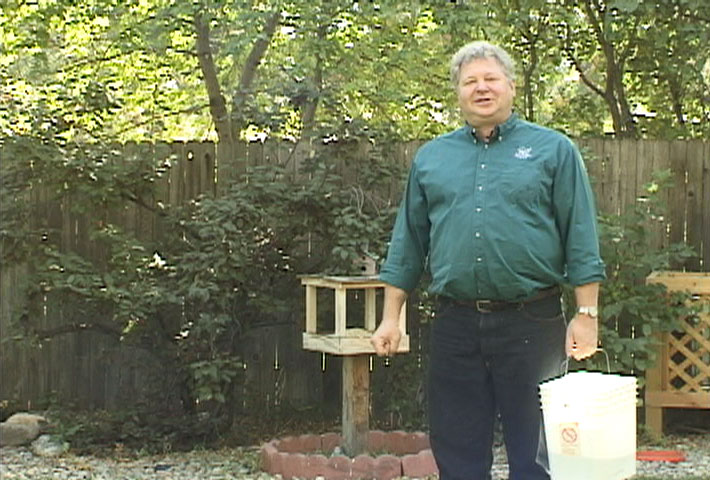 |
Welcome to the Boulder Bird Man video blog. Steve Frye owns the Wild Bird center in Boulder. Every Saturday morning at 7:00 A.M. he leads a bird walk and talk for birder of all levels. Steve has remarkable knowledge about local birds, migrations and habitats and we are honored to have him as part of our shows here on the Channel 1 networks. Look for a new blog each month right there. Check out the Wild Bird Center website and make sure to tell Steve you saw it. For more information on the Boulder Bird Man walks email Steve: wbcboulderco@aol.com. Make sure you stop by the store too. It is the only bird store in Boulder. The staff are all birders so you’ll get your questions answered. Look for the Boulder Bird Man on our Colorado Magazine on CET channel 5/4 all over Colorado.
Steve Frye grew up in the woods of Minnesota where he began a lifelong interest in natural history, especially birds, at a very early age. After graduating from St. Olaf College with a degree in chemistry, Steve joined the Peace Corps in Kenya to teach high school science. The incredible birdlife in Africa intensified Steve’s birding zeal. Steve worked as a chemist for a short time after returning from Kenya. He eventually settled in Colorado and opened the Wild Bird Center of Boulder in January 1989. The Wild Bird Center, with the support of its customers, has provided the community with quality bird products and educational opportunities since that time. Steve married Julie Graf in 1997 and they have 2 children, Genevieve and Charlie.