





To advertise please call 303-447-8531

Oct 8th
In this interview, tech entrepreneur and investor Dan Caruso sits down with Jann Scott to discuss Colorado’s economic future, local housing, and political shifts ahead of the 2026 election (0:27).
Having moved to Boulder County in 1998 (0:47), Caruso was a founding executive of Level 3 Communications (now Lumen) (1:00) and the founder of Zayo Group on Pearl Street (1:20). Throughout the discussion, he focuses heavily on why he has stepped into the political arena to campaign against policies he believes are harming the state’s innovation ecosystem (0:27).
https://youtu.be/DT5q8uHgDk0?si=JvEySbKtU-eUevDy
📉 Pushback on Tax Initiatives & The “AI Act”
• Amendment 87 Opposition: Caruso speaks passionately against Amendment 87, a proposed graduated income tax measure (6:13). He argues that taxing high earners will backfire, driving wealth, investments, and jobs to lower-tax states like Texas and Florida (6:23).
• The AI Legislation Fallout: He highlights a past Colorado “AI Act” which he claims initially “outlawed AI” and stifled immense business momentum (5:50). He notes that while parts were eventually walked back, it sent a message to tech companies to take their capital elsewhere (6:03).
🏙️ Vacancies and the Shifting Vibe of Boulder
• Empty Business Parks: Caruso notes that office spaces on the east side of Boulder and along Pearl Street are facing severe vacancy issues compared to just a few years prior (17:33).
• The “Daily Camera” Building Purchase: To spark a revival, Caruso mentions that he recently purchased the 200,000-square-foot former Boulder Daily Camera building (which houses the Galvanized tech space) at a fraction of its replacement value (16:35). His explicit goal is to bring the “vibe” and active economic life back to downtown (17:15).
• Declining Local Demographics: He correlates the empty corporate parks with a shrinking population of young, non-student families (17:45), which in turn has forced local school closures (17:45).
🏠 Housing & Local Government Spending
• Critique of Affordable Housing Tactics: Caruso expresses frustration with current municipal affordable housing initiatives (24:38). He argues that building expensive single-family units on premier land next to the foothills limits resource efficiency (35:20). Instead, he suggests building higher-density units in slightly less expensive areas to help more families in need (35:36).
• City Capital Projects: He criticizes the city council’s spending priorities, taking aim at the multi-million dollar campus built for city employees (22:48), pointing out that many city workers do not live in Boulder or come into the office daily (25:42).
🤝 Call for Broad Community Collaboration
• Bridging Ideological Divides: Despite his sharp critique of local policies, Caruso emphasizes his deep respect for local scientists, university staff, and progressives (13:09). He rejects the host’s attempt to label government lab workers as “socialists” in conflict with business owners (12:06).
• The Shared Vision: Caruso insists that everyone—regardless of political beliefs—ultimately wants a thriving economy, safe public parks (33:01), strong education systems (13:51), and a rich local arts and culture scene (39:29). He urges leaders to have open, stubbornness-free conversations to keep Boulder unique rather than letting it turn into an exclusive second-home enclave like Aspen (29:25).
Sep 27th
Police reports are still extremely slow coming in, but I did get one yesterday. It is summarized below 👇 Anyone not on Nextdoor can view this content here: https://boulderpublicsafety.org/2026/09/25/reporting-update-9-25-26/ As always, you can view my entire collection of reports here: https://boulderpublicsafety.org/ * Reminder, the more people share these links with others and click on them, the higher they will rank as Google search results. This is something very easy which you can do to help me. * Presently,

I have approximately 37 outstanding requests for incidents dating back to July 10th (now well over two months ago). The police have repeatedly stated their records department is short-staffed. However, per City Council’s study session materials from last night (9/24), 12 of the department’s 13 records positions are currently filled. No one on council raised the issue of the records backlog. Reports I have requested but not yet received include: 9/16: A Menacing J/O (just occurred) at 14xx Canyon. This would have been at or near the Circle K downtown. A man was arrested on charges of: 2nd Degree Assault – Sbi – Police Officer – Strongarm – (F4) Criminal Attempt To Commit Class Three Felony – (F4) Criminal Mischief – Private – [$300 to < $1,000] – (M2) Obstructing A Peace Officer/Firefighter/Emt – (M2) Robbery – Street – Strongarm – (F4) => This man was booked under the name “John Doe.” As of 9/25, the Boulder County Jail listing still identifies the man by that name. 9/18: Another Menacing J/O (just occurred) at 12xx Canyon Blvd. This would have been at or near Central Park. A man was arrested on charges of: Menacing – Intimidation – Use/Simulate Firearm/Knife/Budgeon (F5) Possession Of Drug Paraphernalia – (Dpo) Unlawful Dist/Man/Disp/Sale/PWID – Amphetamine – PWID < 7 Grams (DF3) Unlawful Dist/Man/Sale/Poss/PWID – Fentanyl/Synthetic Opioid – < 4 Grams (DF3) 9/19: Yet another Menacing J/O (just occurred) at 16xx 30th Street. This would have been at or near the King Soopers on 30th A man was arrested on a charge of: (Legacy) MENACING – AGG ASSAULT – WEAPON – (F5) => At the man’s 9/21 court appearance, the judge ordered him to stay away from this King Soopers and specified he wasn’t allowed to have any weapons, including knives. 9/19: A Menacing C (cold), at 12xx Canyon Blvd (also Central Park). This call generated a report; however, I don’t know if anyone was arrested. ~~~~~~~~~~~~~~~~~~~~ THE ONE REPORT I HAVE GOTTEN SINCE 9/13: 8/26 1325 Pearl Street, the Pearl Street Mall 6:50 PM Officers responded to the mall after receiving reports of a shirtless man yelling that he was going to kill people and stealing a chair from a deli near Broadway and Pearl. An employee told police the man had entered the restaurant several times before taking the chair and leaving it in an alley, where employees recovered it. Police contacted the man near the public restrooms at 13th and Pearl. According to the report, he repeatedly yelled racist and homophobic slurs, refused to identify himself, and asked for a blanket because he was cold. Officers gave him an emergency blanket, but he discarded it and asked for a hoodie instead. Police said he became increasingly hostile, advanced toward officers, and repeatedly reached into his pockets despite being told to keep his hands visible. An officer drew a Taser, and the man eventually removed a lighter from his pocket and threw it on the ground. Officers then took him to the ground and handcuffed him. The man asked for medical attention and was taken to Boulder Community Health before being booked into jail. Police said he continued yelling racist and homophobic slurs at the hospital and made a sexually graphic comment to a nurse who was helping him. He later began thrashing on the hospital bed and kicked an officer’s hand. (The officer was not injured.) After being medically cleared, the man allegedly got off the bed and tried to move toward the door while an officer was outside retrieving a spit hood. Another officer grabbed his handcuffs, called for emergency assistance and took him to the floor. The man was taken to jail. The original police report listed charges including 2nd Degree Assault on a Peace Officer, Obstruction, Theft Under $300, and an attempted felony charge that is not further clarified in the report. Police also recovered 12.64 grams (about 0.44 oz) of marijuana. The man was scheduled for a preliminary hearing on 9/24. As of 9/25, the Boulder County Jail listing shows only one charge, misdemeanor 3rd Degree Assault. The available records do not indicate what occurred at the 9/24 hearing or explain the reduction in charges.Reporting Update — 9/25/26boulderpublicsafety.orgCommentShare
24 reactions10 commentsAnn S.2d·WhittierNothing says welcome to tourists and the dinner crowd like racist & homophobic slurs as well as threats of physical violence, Sundance is going to love this kind of local color. Thanks for getting this report!Reply
10Todd R.2d·Author·WhittierAnn The report was very graphic about the racist and homophobic slurs the man was using at officers. The sexual comment that he made to the nurse at the hospital was also quite graphic. It’s too bad Nextdoor wouldn’t allow it to be reprinted as a quote.Reply
4See 2 more repliesCathy D.2d·The HillThank you, Todd, for your time and work to keep us informed.Reply
13Graeme Forbes1d·East BoulderIndeed, Cathy. Thanks Todd.Reply
1Liana Patterson1d·Hillsborough NorthTerribleReplyTodd R.1d·Author·Whittier
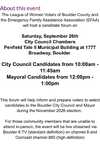
There is a city council candidate forum tomorrow (Sat) at the Muni building from 10 AM – 1 PM. This is your chance to meet the people who will soon be ignoring your concerns about public safety 🎉 https://lwvbc.org/content.aspx?page_id=4091&club_id=629866&item_id=3043309Reply
6Roxanna Walker1d·The HillTodd hoping for another chance. These dates don’t work for us.ReplyEmie F.1d·Winding TrailAnother day in the emergency department!
Jun 1st
FROM The Boulder Bulletin/June 2026
This would seem like a good problem to have. Over the course of several decades, the
City of Boulder has amassed a portfolio of 80 buildings around town, worth a total of about one
billion dollars. Many of them are falling apart.
The dozens of structures owned by the city include necessary municipal facilities, like
fire stations and police headquarters. But there are also some unusual holdings that came into the
city’s hands through accidents of history, such as a large Victorian house on University Hill
which the city bought in 1979 to host Parks & Rec programs, but which the city now leases to
the nonprofit Women’s Wilderness.
The city owns seven public parking garages, and a handful of buildings used to provide
water utilities. Five of the structures owned by the city are library buildings, which the city leases
to the Boulder Library District, now a separate government entity.
The condition of the city’s properties varies widely. With more than half of the structures
built before 1970, city staff estimates that the deferred maintenance on their buildings totals more
than $500 million. Staff has identified funding for only about $100 million of this, leaving a
$400 million gap.
Having $1 billion in real estate with $400 million in unfunded deferred maintenance is
like owning a $1 million house with $400,000 in needed repairs but no income to cover the costs.
Where would you even begin?
The failing city building which has attracted the most attention recently is the South
Boulder Recreation Center. One of three recreation centers operated by Boulder, city staff
estimates that the cost to replace it will be between $30 and $65 million, depending on what
amenities are included in the new building. The two other city rec centers are not far behind,
each needing $60 and $80 million in renovations over the next few years.
Boulder’s public safety facilities are likewise in poor shape. Half of Boulder’s eight fire
stations need an additional $10 million each to maintain them. But city staff says that the
building that’s in the worst condition is the 50-year-old Public Safety Center on 33rd Street,
which houses the emergency dispatch operations and the police department, and which will need
$100 million for renovation or replacement.
Of course, many of the city’s 80 buildings simply need to be disposed of. Some have
surpassed their economic useful lives, and it makes no sense to renovate them. At least three of
the city buildings are slated to be demolished after the municipal employees who work in them
relocate next year to the new city office building at the site of the former BCH hospital complex
at Broadway and Alpine (how much that is costing to build is a topic for a separate discussion).
©2026, Bob Yates. All rights reserved.
Other municipal buildings will be sold or otherwise disposed of, including the Atrium
Building at 13th and Canyon, which the Farmers Market aspires to convert into a year-round
market hall.
The city will also need to decide what to do with a dozen buildings that it owns but leases
to others at below-market rates, including the library buildings, the Pottery Lab, Chautauqua
Dining Hall, and the BMoCA building. The city manager has declared that the city no longer
wishes to be a landlord. Some of the leased buildings could probably follow the path of the Dairy
Arts Center building, which the city had been leasing to the nonprofit for $1 per year for more
than 25 years, before selling the facility to the arts organization last year.
You might ask how the city got into this hole, facing $400 million in unfunded
infrastructure deficiencies. It’s like how someone goes bankrupt: Slowly, then all at once.
Indeed, the decline in the condition of city infrastructure has been growing for many
years. In 2008, a city blue-ribbon commission forecasted that the city’s expenses over the
following two decades would outstrip its revenues. They were right.
In 2011, four years before I was first elected to city council, I co-chaired a 16-member
residents’ committee appointed by the city manager to somehow allocate $49 million in expected
city bond revenues across $700 million in municipal capital needs. We did the best we could with
what we had.
Fifteen years later, the current city council finds itself in the same pickle: Too many needs
and not enough money. So, they’ll do what city councils in every city must do: Prioritize. They’ll
apply their understanding of community values to fund some things and abandon others. Do we
need eight fire stations, or will six or seven do? Is three the right number of recreation centers?
How about two? Why not four?
And invariably, rather than simply slicing the pie thinner, city council will consider
increasing the size of the pie by growing the city’s revenue and therefore its capacity to pay for
more things. Council did just that in mid-May, instructing city staff to investigate several
potential tax increases for this fall’s ballot, including:
• A permanent property tax increase that would add an annual $86 per $1 million in
home value ($338 per year for each $1 million in commercial property value).
• Municipal debt limit increases, including a temporary property tax increase to pay for
it.
• A special property tax for homes that are not lived in by owners—or rented out to
tenants—at least half of the year.
City council authorized city staff to survey the community’s feelings on each tax
increase, with the poll results to be published at the end of this month, in preparation for
council’s decision which measures to put on the fall ballot.
©2026, Bob Yates. All rights reserved.
Having read tens of thousands of constituent emails during my eight years on city
council, I can predict what many people will say: (a) Give me the municipal service I want; and
(b) tax someone other than me to pay for it.
That might sound cynical. But it’s human nature to satisfy our needs while sacrificing as
little as possible. In that respect, the relationship between residents and their city government is
inherently adversarial. Residents want things the city can’t provide. And not everyone wants the
same things.
City council members get to be professional disappointers, making zero-sum tradeoffs:
Every dollar spent on Thing One is a dollar that can’t be spent on Thing Two. So, we’re going to
have to get along with fewer things. And maybe a rec center or a fire station gets closed, with the
resulting impacts on services. In the Happiest City in America, people might have to accept
being a little less happy.